
Cairo’s GARBAGE CITY – an incredibly fascinating trash metropolis that somehow – albeit a bit smelly, dirty, and rat-infested – manages to take in, sort, repurpose, and recycle around 85% of the rubbish of 20 million Cairo dwellers. Wow.
And yes, they do this with their bare hands. Trash comes into Garbage city in trucks, and gets dumped in a big lot that functions as stage 1 of a million-stage project. Stage 1 is the initial sorting – often done by men and women with their bare hands sitting half-hidden by overflowing piles of other peoples’ trash. We walked into this part when we arrived on our Garbage City Cairo tour, by a friend of a friend.
If you are visiting Cairo, make sure to check out my guide below.

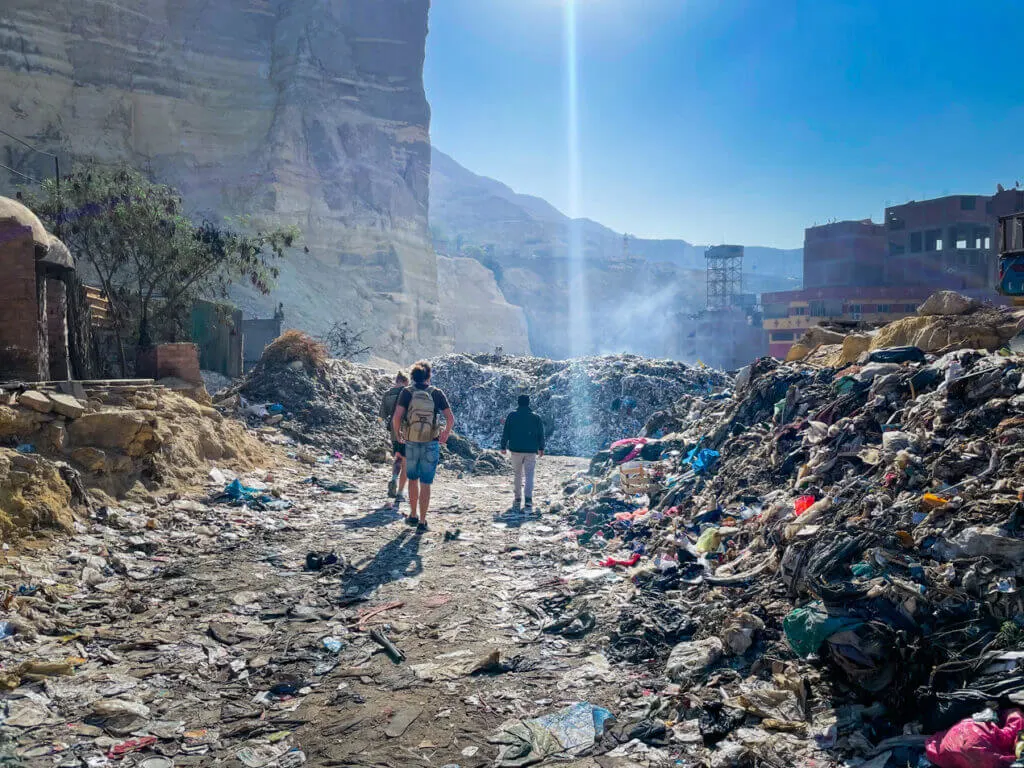
The smell of this part hit me in the face like a ton of bricks. I made my way through the different trash mountains, some more picked-through than others. To one side the trash mound looked almost like dirt with different colored bits sticking out of it – I figured that one had already been sorted.
To the other? Among piles of plastic bags and old plastic takeaway boxes, I saw some raw picked-after piles of big meaty bones sitting in a corner. “Lunchtime, Kimmie?” Eliot asked, motioning to what may have been a cow carcass at some recent stage. The only appropriate response to that was the sound of a dry wretch – a fake one, but who is going to judge?
What IS Garbage City Cairo?


So what IS Garbage City? I was confused about it before I went, also. The official name is Mokattam. Garbage City is an actual living, functioning city suburb that also has shops, bakeries, butchers, churches, high-rise apartments, families, schools, and artists.
The major difference? The fact that ALL the trash of Cairo is brought here and most people are employed in one way or another in the trash sorting and recycling process. They even put Europe’s recycling rates to shame.
The ground floors of most of the buildings are literal trash factories – with bags of one type of trash or another lining the floors and walls, oftentimes with a complicated contraption of a machine performing a certain function with a certain type of trash. When passing by any open door, we’d see eyes light up on a sweaty working face inside the building – ‘HELLO!’ They would all say, waving at us, intrigued to see foreigners in their hometown.
The word used for it here is “Zabaleen,” which translates literally in Arabic to “garbage people.” The Zabaleen make this place run by turning their own tiny cog in the massive machine.


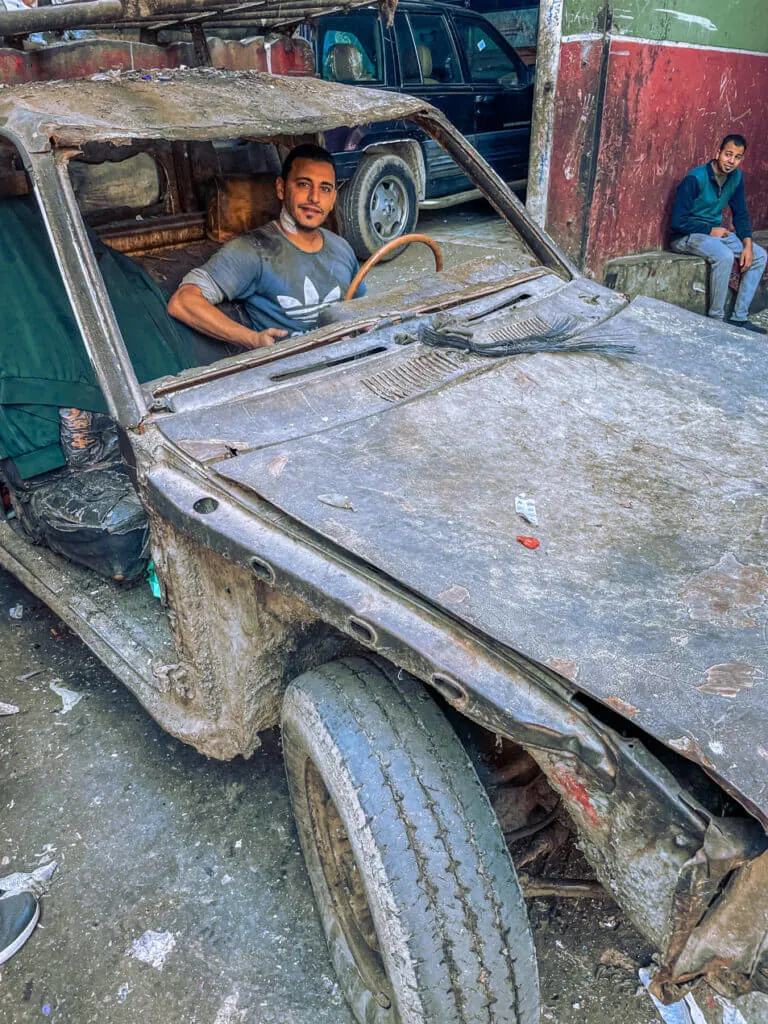
Somehow, this car still functioned. 
Bags of green plastic bottles

Garbage City has one of the highest concentrations of Christians in Cairo – about 90%. Walking the streets will reveal hundreds of posters and trinkets of the Virgin Mary and Jesus himself.
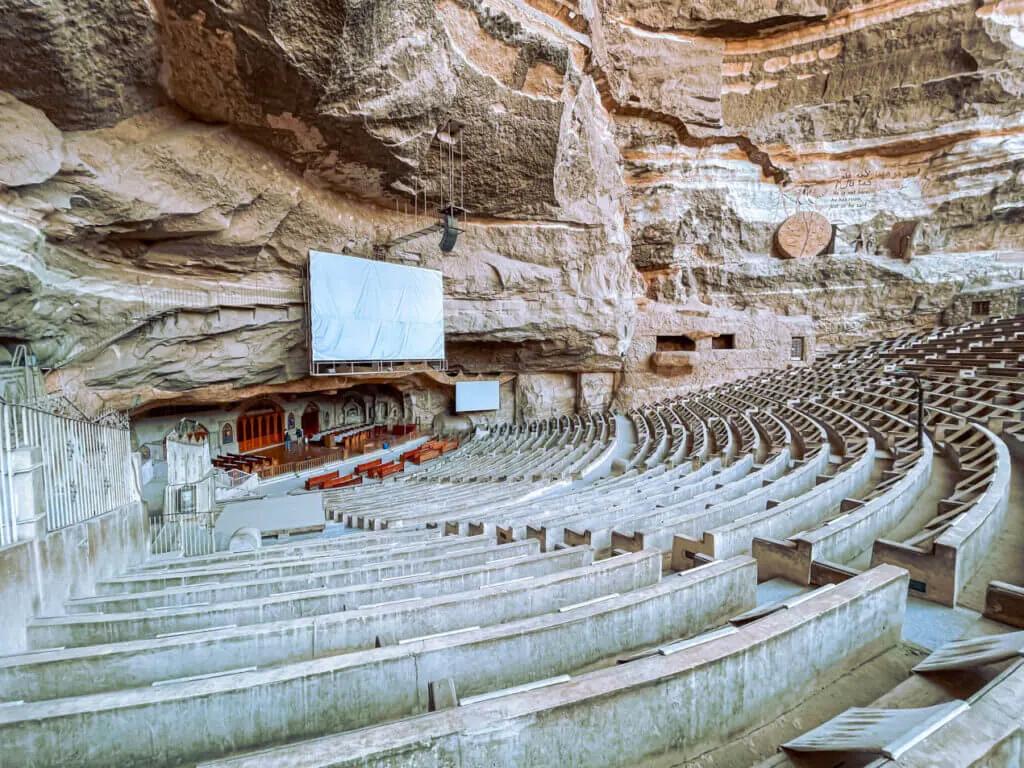
Nestled 10 minutes up into the hill bordering Trash City is the St Simon Monastery – a complex of 5+ different churches built into caves in the huge cliffy mountain overlooking trash City. The biggest church and a Cairo tourist attraction, The Cave Church, can hold thousands of people at once.
Trash City is one of the only places in Cairo you can find pig bacon – they actually use pigs to sort through organic waste, plumping them up before they eventually become dinner.
One of the craziest stories we heard here is that, at some point after Trash City was functioning in the Christian community, the president had ALL their pigs killed and tried to outsource the trash sorting to a French company. This failed miserably and he eventually gave the task back to the community at Mokattam.

Garbage City Sorting Process + Stages
Anyway, back to stage one of the garbage sorting process – where the trash comes straight from the collection trucks.
At the first stage, the inhabitants of the stage one area separate all the parts… and each part has a different purpose and a different ‘stage 2’ to go onto after that. They separate everything – the plastic (bags, fiber, clear bottles, green bottles, takeaway containers, PVC, etc… they have over 100 different types of plastic alone), the metal (aluminum, copper, wire, etc), glass in different forms, paper, cardboard, bones, organic waste, and more.
After this is separated, they will SELL the items on to the second round of garbage sorters at stage two. The payment happens in stages – sometimes the sorting people will sell their plastic bags right to the guys next door.

Takeaway containers 
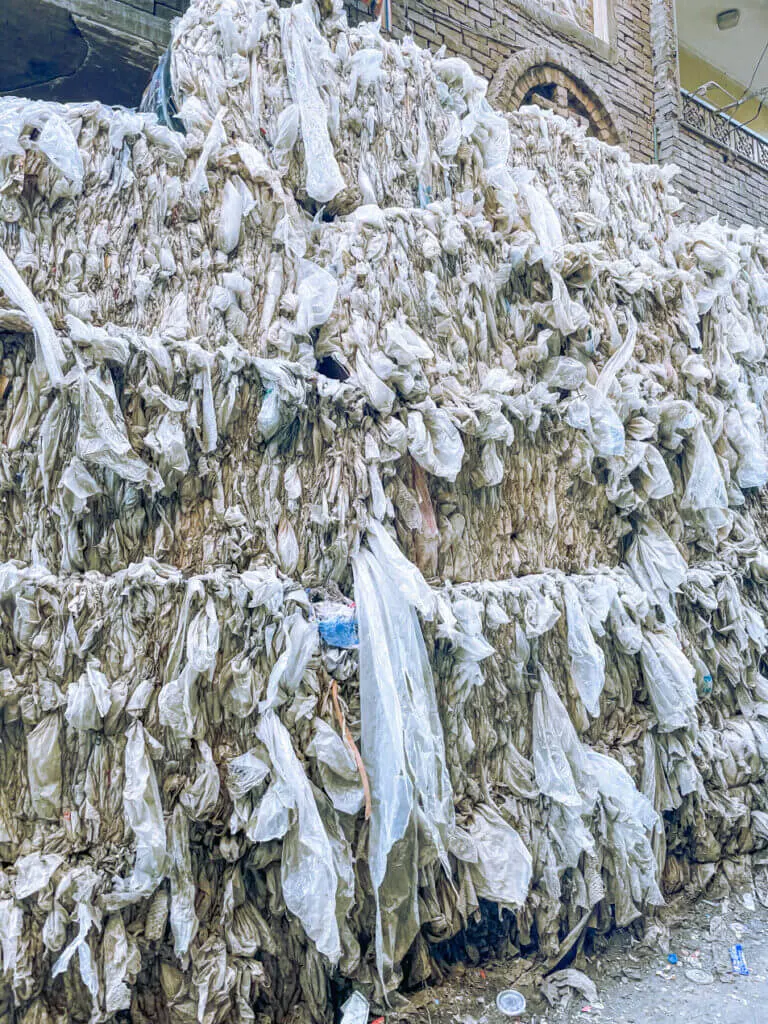
White plastic bags 
Aliminum


Plastics + Other Materials
The first part we visited was the CLEAR plastic bottle section. There were a couple of Zabaleen guys standing up in a machine grabbing bottles from a huge chute that had already been separated, and putting them in a huge plastic fiber cube for compression.
Next to them on the floor were a few massive cubes of compressed bottles – each cube with hundreds if not thousands of bottles.


We learned here that Nestle and Pepsi actually pay this portion of Trash City to recycle all their plastic bottles. Our guide said they have over 2700 people on their payroll!
We visited a small factory that takes plastic bags into a huge multi-stage machine – first washing and cleaning them, drying them, shredding them, and then dispensing them out. Apparently, they take in plastic bags from all over Egypt here, and sell plastic sheets made from these recycled bags to Canada and all over the world.


We visited two side-by-side factories that convert thick plastic bags into pellets. These plastic bags were thicker- more like the stringy plastic fiber bags that would be sandbags, rice/flour bags, or reusable grocery bags.
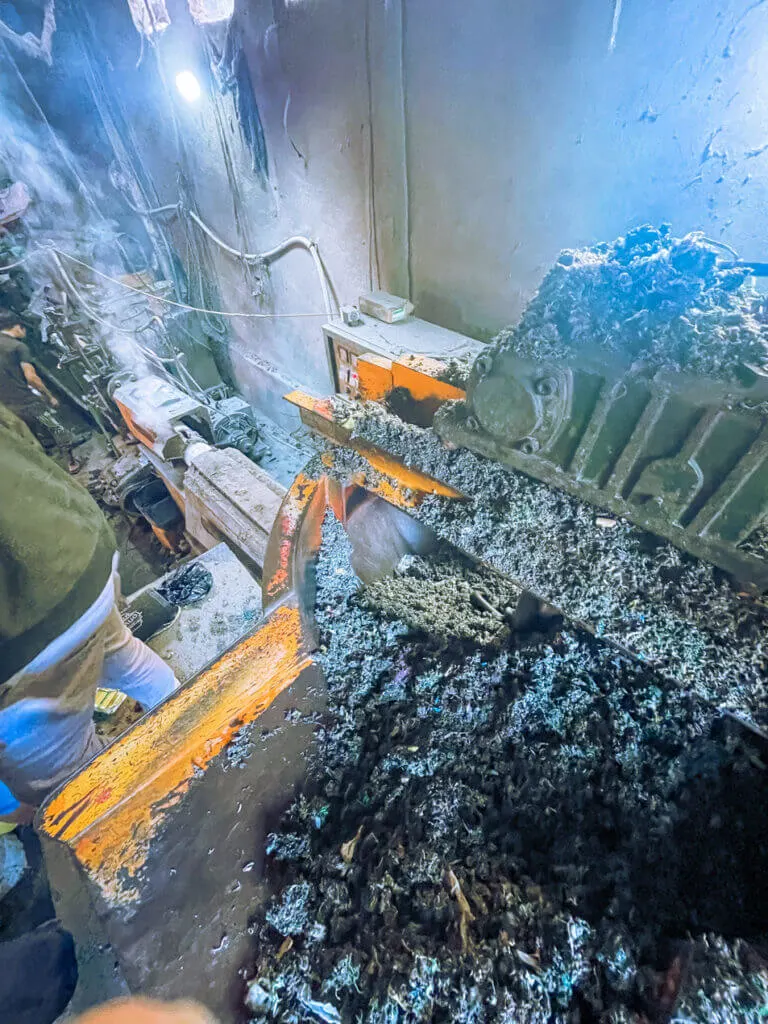
The first room housed two machines that shredded them up into smaller dirt-like bits. The second room machines (and the Zabaleen guys 😉 took these dirt-like bits, melted them, converted them into long gooey strings, dragged those gooey strings through a long tub of cold water, and then sliced them up into plastic pellets. Straight from trash to a new item within hours. Pretty mind blowing, huh?

broken-down plastic going in to be melted 
REcently-cooled plastic strings (right) being cut into pellets (bottom left)
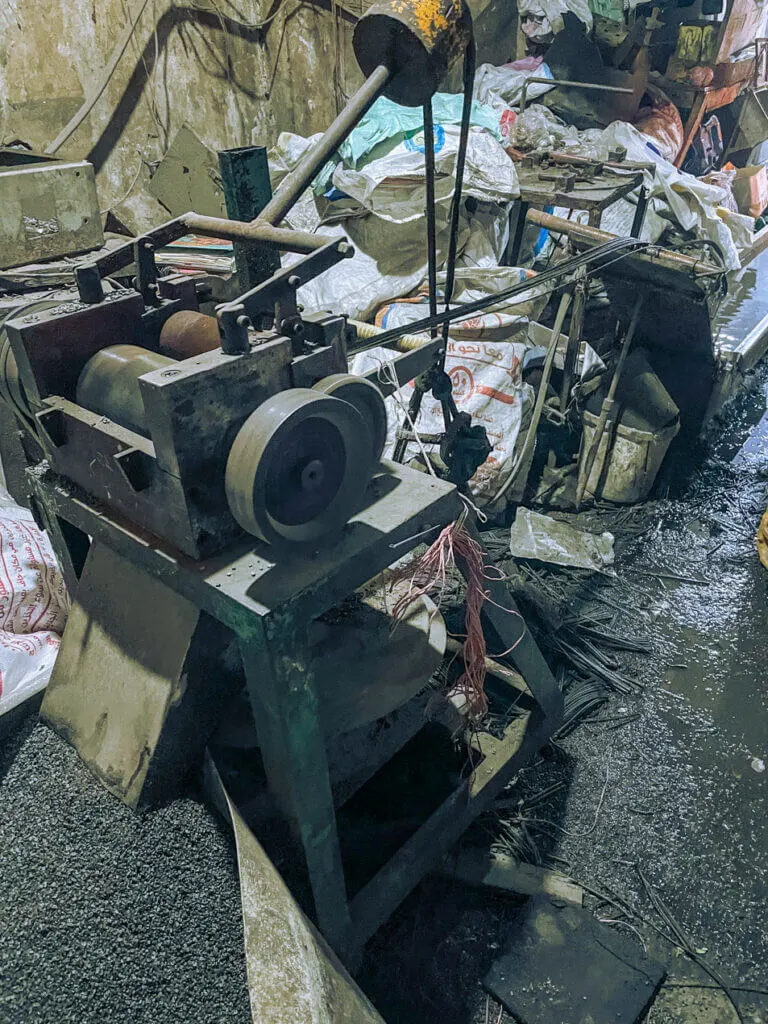
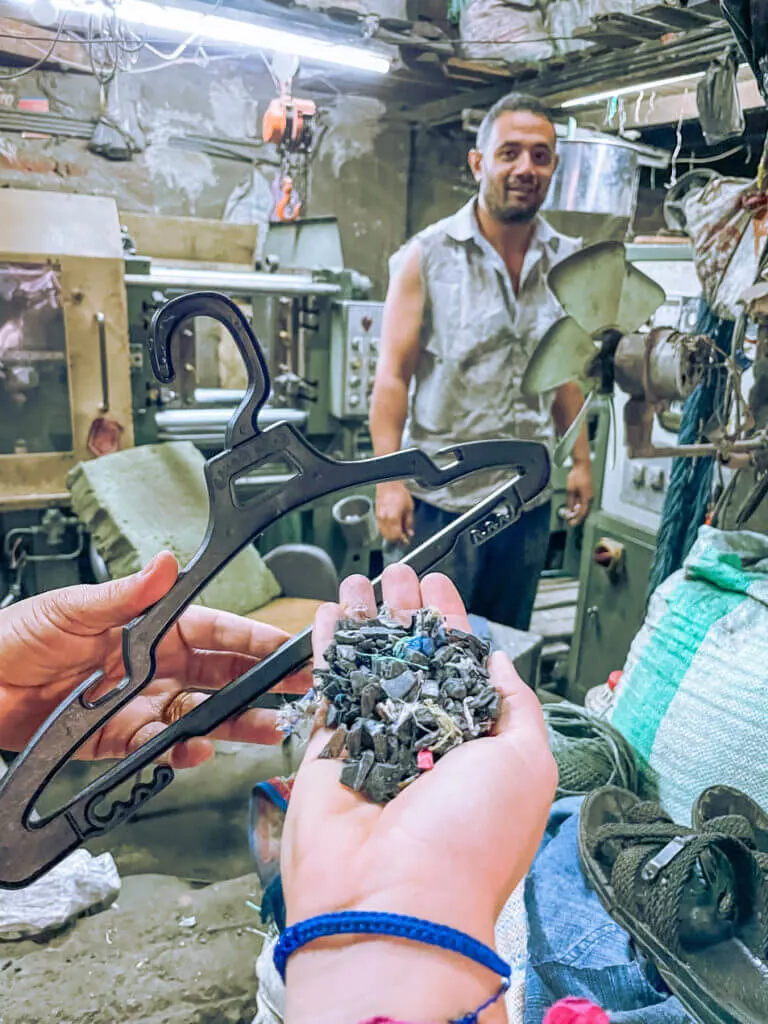
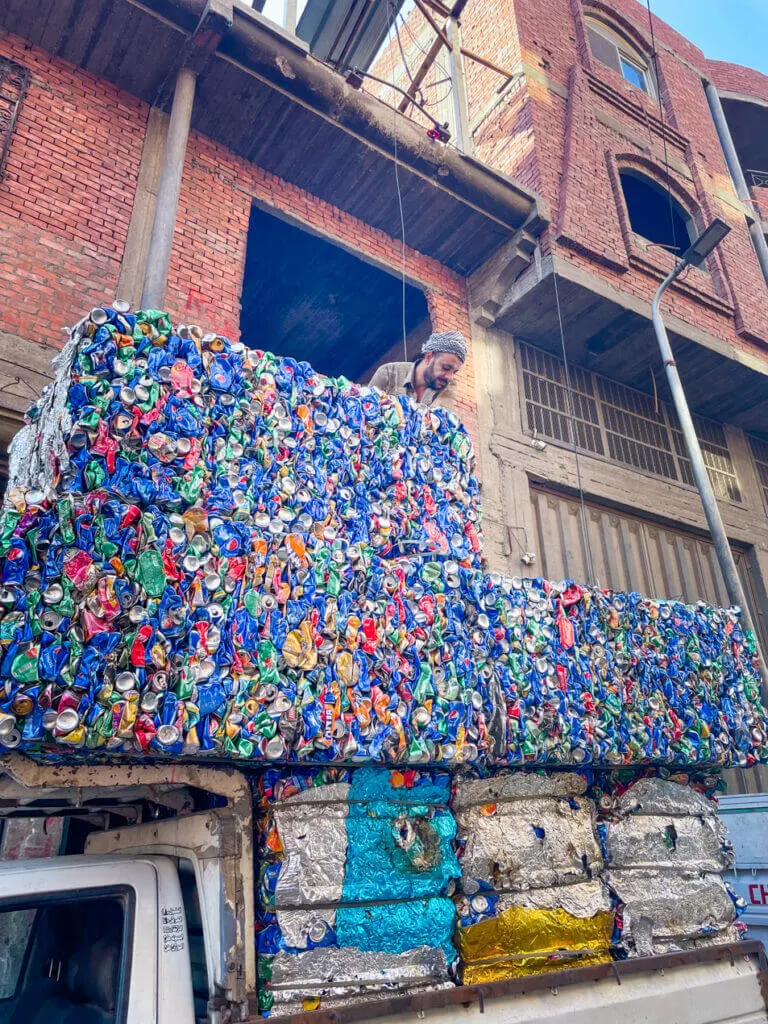
We visited ANOTHER plastic station where they would take small bits of broken-up plastic, melt it, and create clothes hangers. There was an aluminum cans section where they would press zillions of cans into cubes to melt down or sell. There was a similar cardboard station that would press all the cardboard together into cubes to reuse as well.
We learned about how glass is dealt with, too. It’s often washed BY HAND and separated into different kinds of glass. If it’s broken, it goes to be melted, where it’s made straight into other glass.
We passed a room full of bags of lightbulbs, too. Our guide Moussa told us that these are more complex to sort because they are comprised of so many different materials all at once. He told us that they must break apart these lightbulbs and can use the glass, the wire, and the plastic base, but the most valuable part is the copper coil inside.

Stage 1 and 2. Boom. 
LOTS of cans
Creativity + Recycling
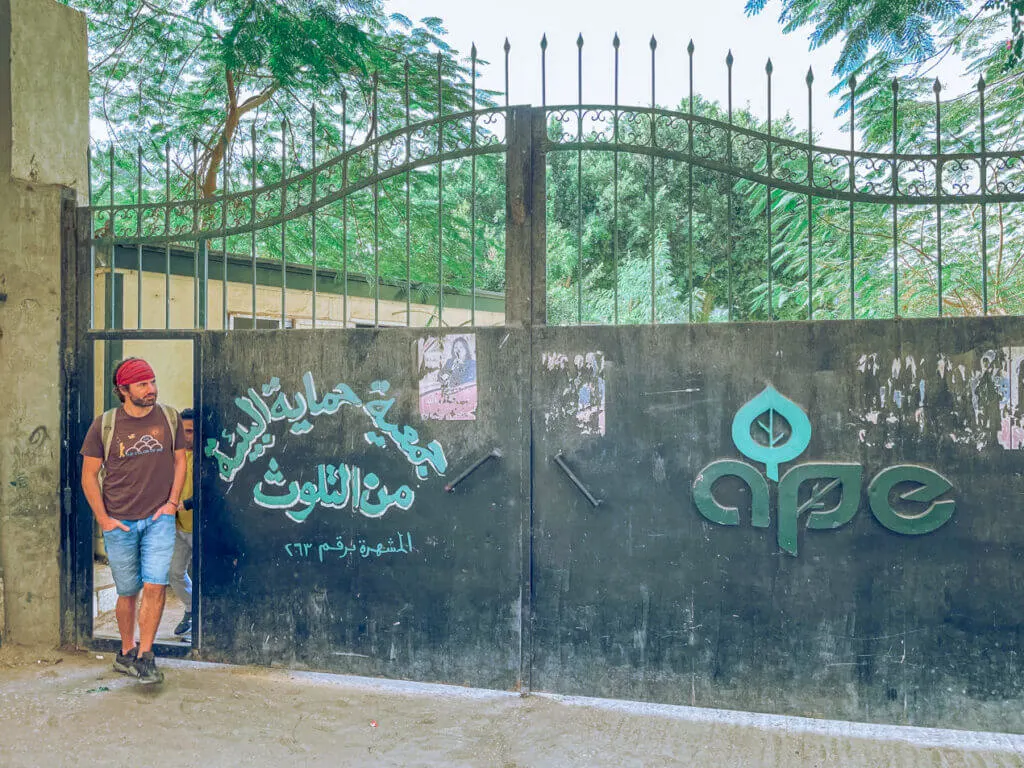
One of my favorite parts of Garbage City was the AEP, which is kind of like the area’s EPA but in a different order 😛 This part of town is much cleaner and is home to classrooms, children’s centers, and a lot of female artists who create art, jewelry, and textiles from different kinds of rubbish.
They also place used paper in huge tubs to recycle the paper into new paper that they make greeting cards and lovely stationery from. They actually have a fantastic website where you can even buy products online – check it out here!
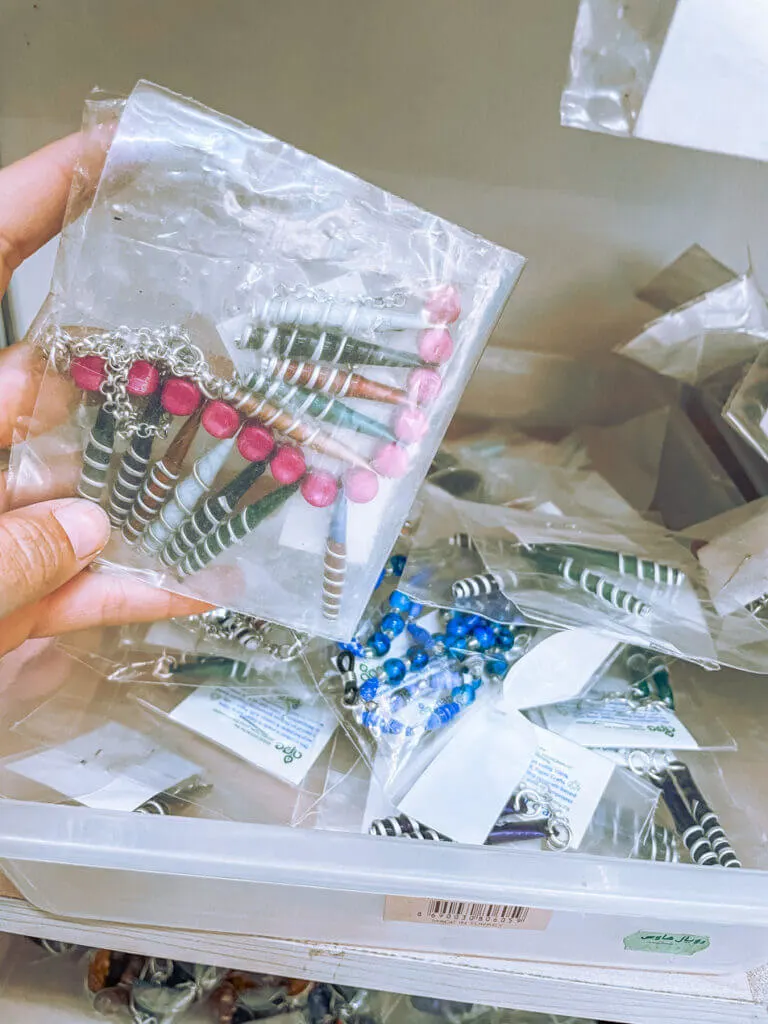
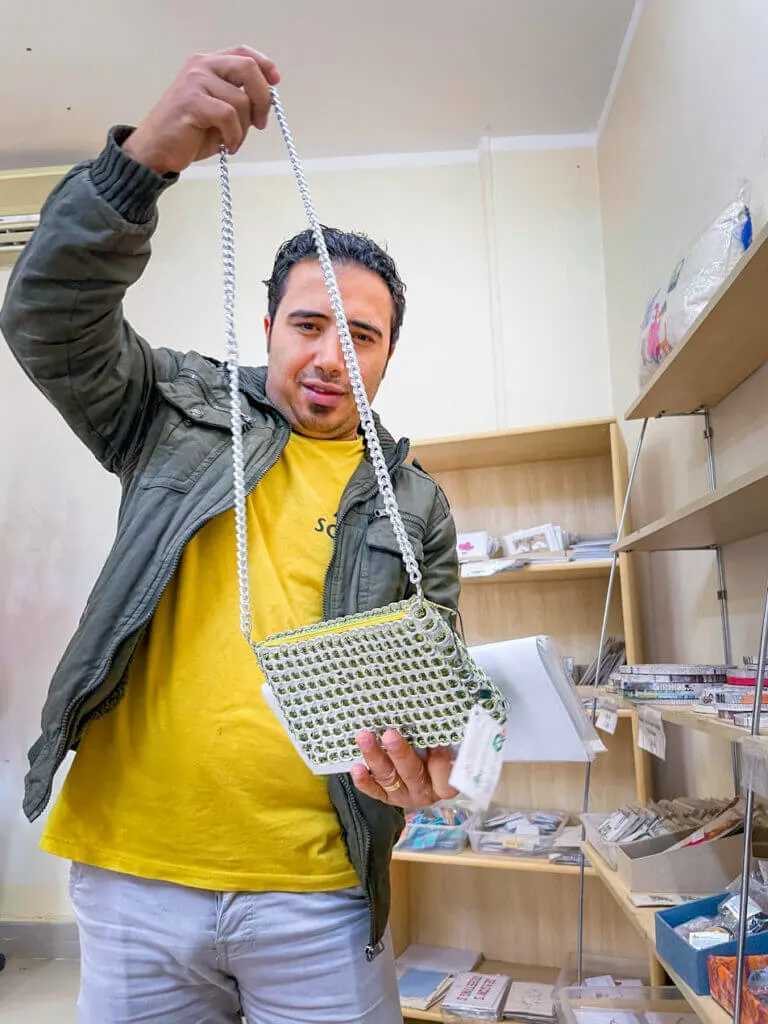
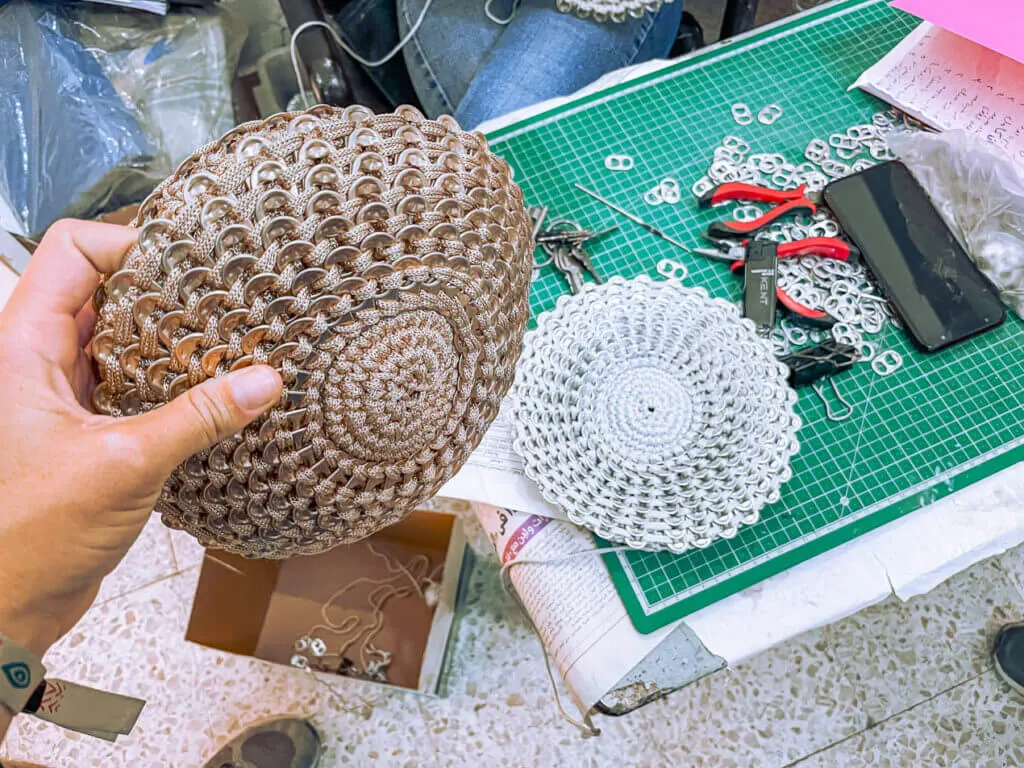
In this area, they have a few shops where you can view incredible art made from recycled items. You can buy handbags, wallets, and purses woven with can pop-tops, necklaces created from recycled magazine paper, and jewelry adorned with creative twisted-up and crushed coffee K-cups.
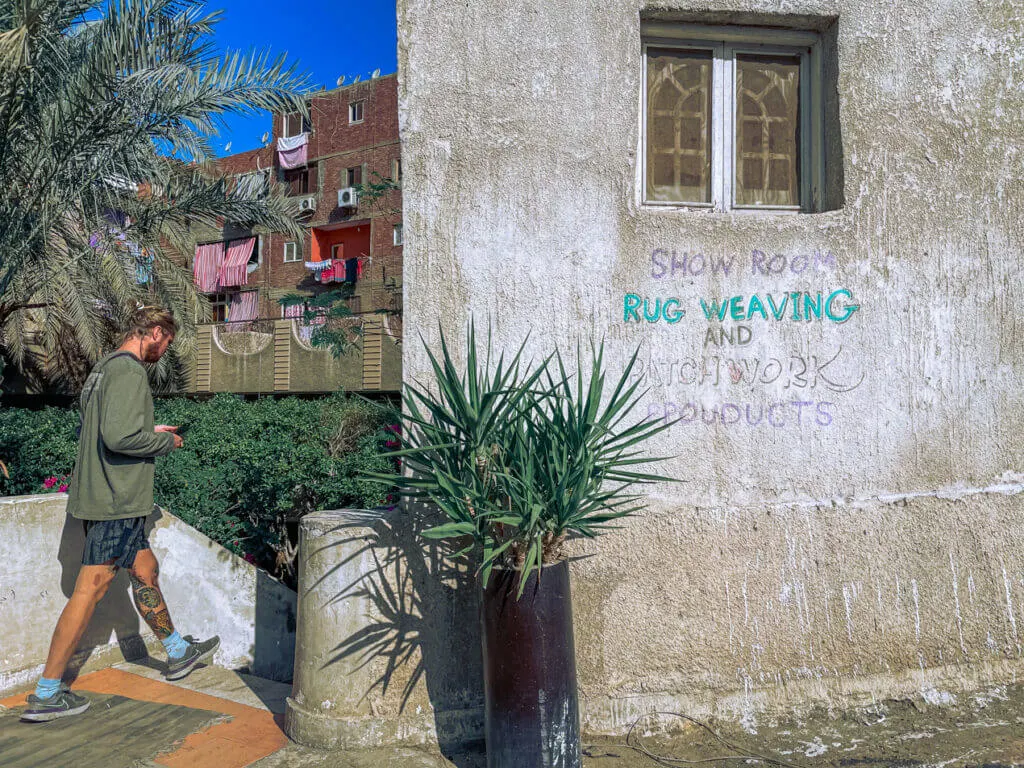
You can buy hand-woven bathroom rugs, purses, and pillowcases and so many creative reused items made to look beautiful. You can visit their website to view products


Earrings made from rolled-up nescafe cups 
recycled purse


A New Meaning of ‘Trash’
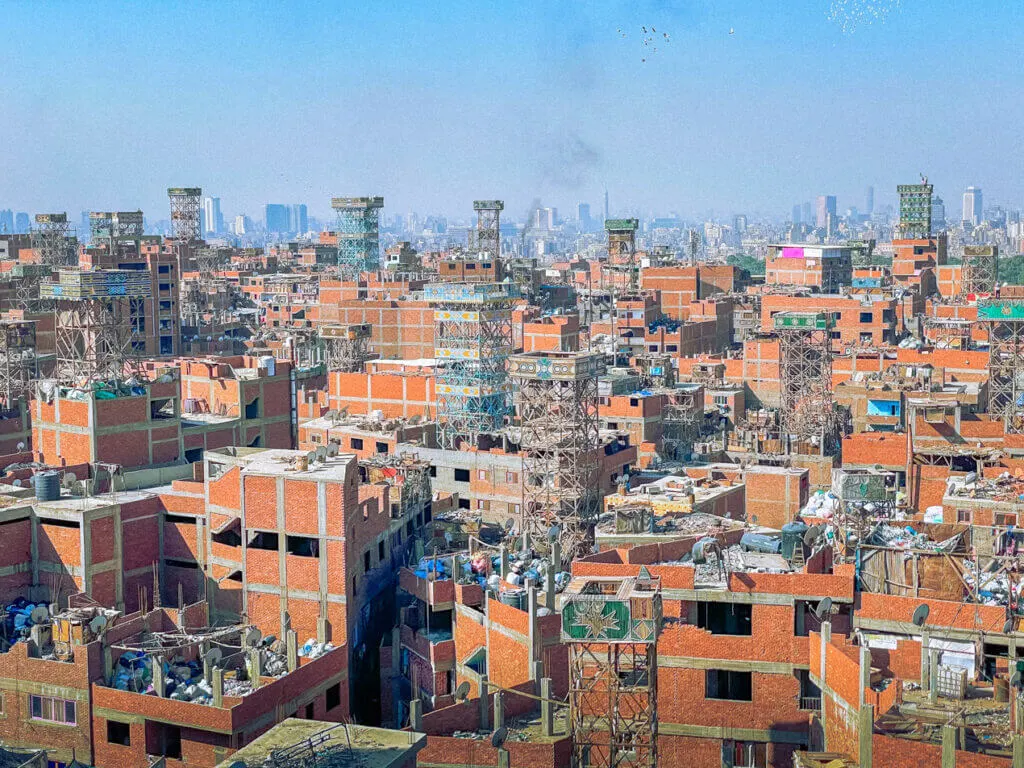
Garbage City has a few dozen ‘pigeon towers’ where hobbyists keep pigeons for a hobby. As I understand it, they use them often for breeding, betting, or even eating eventually (stuffed pigeon is a delicacy here).
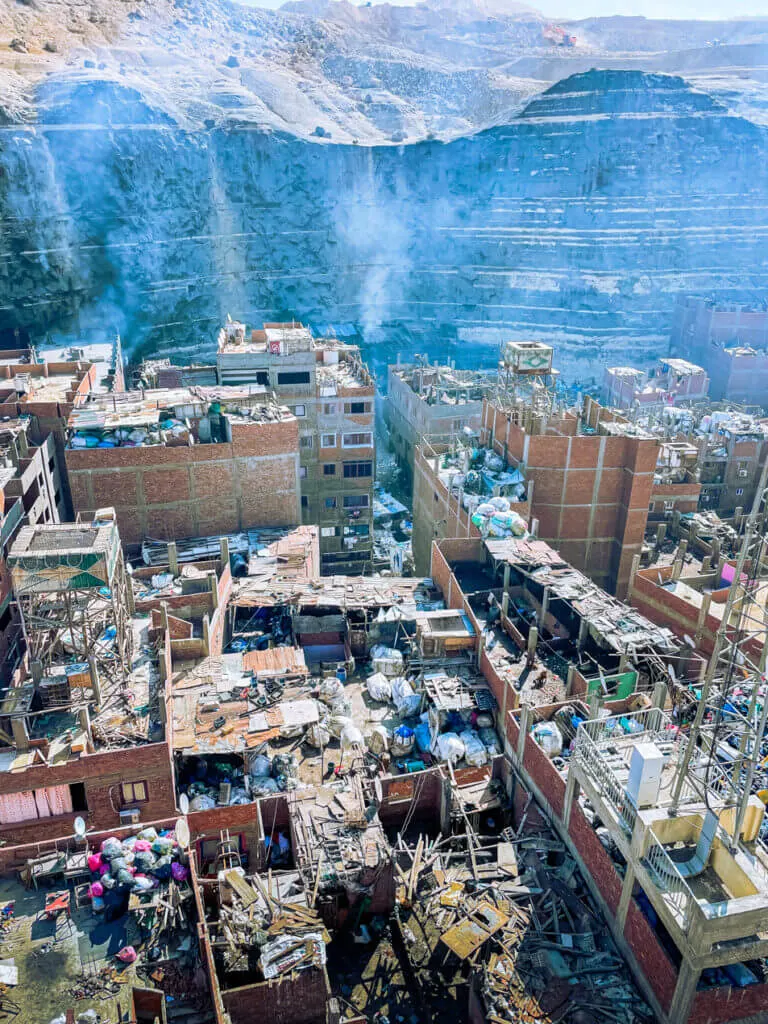
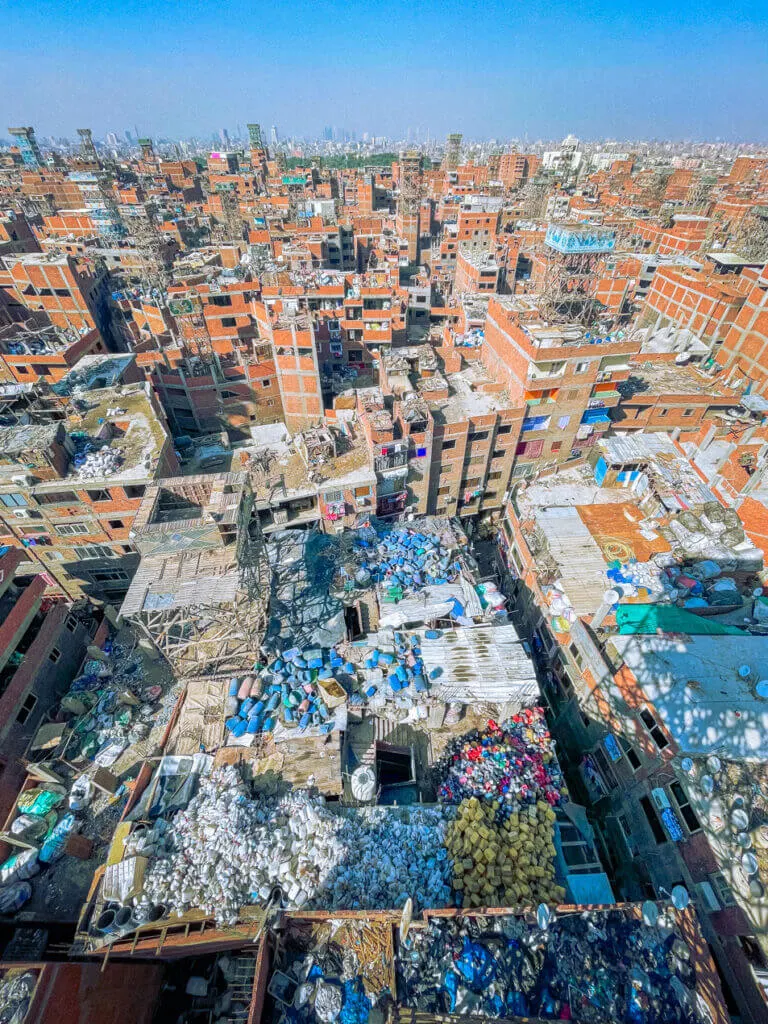
From these pigeon towers, you can get the BEST view over the well-oiled machine that is Garbage City from here – zillions of rooftops with half-sorted rubbish going off into the distance for miles, with mosques dotting Cairo’s horizon.
We saw a few different colors and breeds of pigeons, and even tossed some food out for them to eat. But of course, we were more interested in the views.

View of Garbage City 
Stairs to the Pigeon tower… HOLD ON and don’t look down!
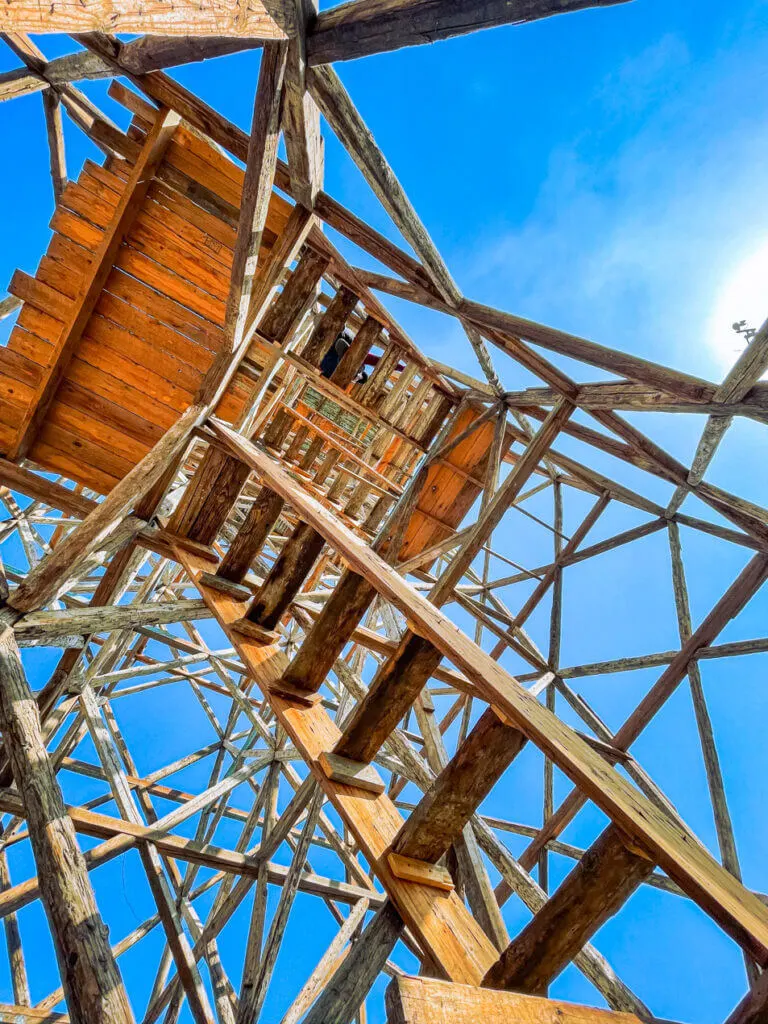
Walking up to one of Garbage City’s many pigeon towers, we waded through even more trash strewn about a dark back room of one of the buildings – with a few people sitting in the middle of it, sorting. We cleared a pathway to go up the stairs, but barely.
“Wow, the trash really is everywhere isn’t it?” I remarked in passing while stepping over more baggies and unshapely boxes.
“It’s not trash; it’s materials. And materials mean money.”
This comment moved me in a way that actually made me realize the gravity of the significance of trash here. They don’t even see it as ‘trash.’ They see it as mixed materials, each of which has a certain value. When you separate this value, you can create wealth.
This made me really think about TRASH in itself. What is trash? Trash is waste – our waste. In our house, everything that goes into the trash is something we probably have just been using or eating ourselves. The banana peel that we just peeled and ate. The empty jam jar that we scooped the last few drops from. The old papers. The dead lightbulb. The soda cans. Wine bottles. Remnants of dinner that we just couldn’t finish.

Each thing that goes INTO the trash is not gross at the time. But somehow it’s the mixture of things – the potential coalescence of different food items, and the unknown contents of an unfamiliar trash bag that didn’t originate in our home – that takes it from some food we just finished eating to GROSS.
I’ve never reflected on trash in this way, because as a society we learn to say EWWW and go on with our day. But to the residents of Garbage City, it’s a lifeline.
Garbage Sorting + Health
“But do people ever get sick?” I asked Moussa a bit later.
“Well, the garbage just comes from people’s houses,” he said. “The garbage from people is okay. But the garbage from the hospital? Goes straight to the landfill.”
I had never thought about trash like this before, either. As I mentioned in my epiphany above, we see trash as a gross whole rather than a profitable sum of its parts. Trash from peoples’ homes is okay. But when it comes from the hospitals, THAT’S when the residents get worried.

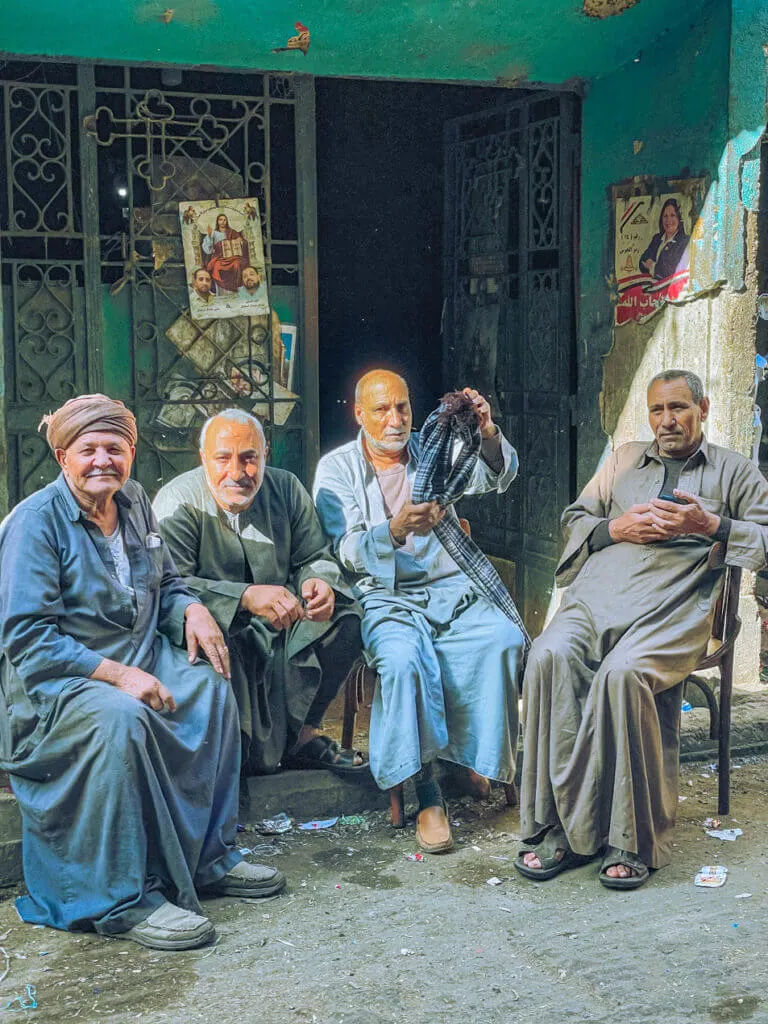
These lovaly guys were happy to have their photo taken. Most people here were not! 
You can see different types of trash from up here
Moousa told me a horror story about someone getting Hepatitis from a needle in hospital trash, which made me shudder. He said hospital trash was especially iffy during c*vid, but he also mentioned that c*vid hardly even ran through this community due to their built-up immunities. Interesting.
I mean, honestly I wouldn’t be surprised if people here had more immunity. At the end of the day they really do live among the stuffs that the rest of Cairo has disposed of. Unsurprisingly the streets are also quite strewn about with rubbish, and I’m not so sure how often cleaning crews go through. This might be a bad thing for sanitation and a good thing for building up immunities to strange diseases.
I walked on and slipped on something – oh, WONDERFUL; it was a half-decomposed dead rat. Disgusted, I wiped my foot on nearly everything I could see. Moussa laughed and told me that it’s normal for them to grab rats by the tail and kill them in the street. Oh, so THAT’s why I thought I saw tails coming out of random muddy blobs on the street. Invigorating! 😛

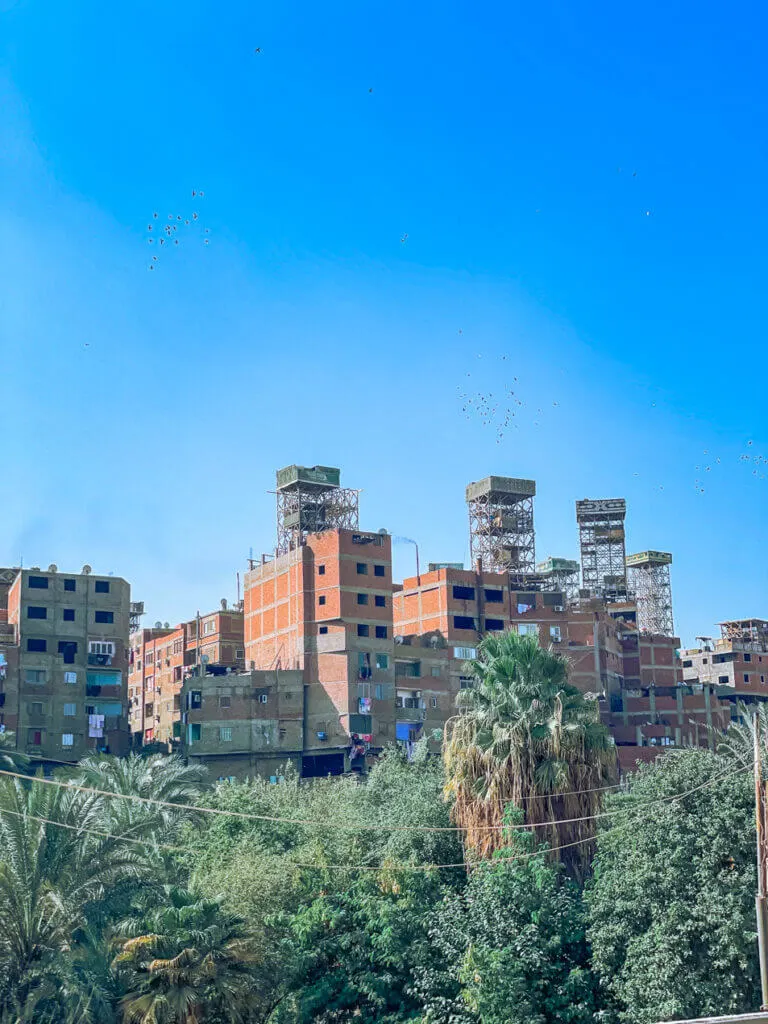
All in all, Cairo Garbage city was a fascinating reframing of some of my conditioned beliefs (while definitely also a confirmation of others)! As we were able to see trash as they do here – as untapped potential, as a source of great wealth, as a bit of a treasure hunt.
If you would like to see Garbage city while in Cairo, you can also set up a tour with Moussa. Send him a message on Facebook or you can contact me instagram to get in touch with him for you!
More on Egypt

Passionate, full-time travel blogger with over 230k on social media and 150kMPV blog. Extraordinary photographer with two DSLR's + a drone with a love for capturing candid moments, epic drone shots, and magical compositions. I'm a natural-born content creator originally from California, but I've been on the road for 9 years living, working, traveling, blogging, and photographing my way around the world. I recommend the most amazingly adventurous and unique + boutique travel experiences/stays and helpful products to my audience and write comprehensive guides on my website that have helped millions of travelers so far. I love to inspire people to plan their dream trips, and many readers have given feedback as such. The reach on my platforms continues to soar, especially when combining cutting-edge social content with optimized articles on my high-authority website.
Cathy
Tuesday 7th of December 2021
That was fascinating and inspiring. Not trash, 'material'. What an experience.