
I did the Quebrada de Humahuaca tour as a day trip from Salta, which I highly recommend as a nice and easy way to see and learn about all the sights in the most hassle-free way possible.
The Quebrada de Humahuaca, or the Humahuaca Gorge, is a 200km long UNESCO World heritage site that displays evidence of being inhabited for up to 15,000 years! It’s in the province of Jujuy, which together with Salta will give you an entirely different vibe than the rest of Argentina – much more indigenous and similar to what you may imagine Peru of Bolivia to be like.
The Quebrada de Humahuaca was inhabited first by pre-Hispanic tribes before being taken over by the Incas and soon after, the Spanish. There is tons of history, rich art and culture, and, by far, some of the most beautiful scenery and colors I have ever seen.
On the Quebrada de Humahuaca Tour, you will see the Cerro de 7 Colores (Hill of 7 colors) in Purmamarca, go craft shopping in Volcan, visit the town of Tilcara and see the ruins of a fortress (Pucara) there, The colorful ‘painter’s palate’ in Maimara, a famous church in Uquia, the beautiful town of Humahuaca, and cross the Tropic of Capricorn in Huacalera – in one awesome, jam-packed day. Make sure your cameras are charged!
But First, Need Any More Argentina Info?
- Guide to Northern Argentina: What to See in Salta and Jujuy
- Riding the Tres A Las Nubes in Salta
- Cafayate 3-Day Itinerary
- Places to Visit in Argentina (You Didn’t Know Existed)
- Complete Argentina Bucket List: Things to Do in Argentina
- What to Do in Buenos Aires: A Complete City Guide
- Northern Patagonia Itinerary
- Classic Patagonia Itinerary
- Visiting Iguazu Falls 3-Day Itinerary


The Humahuaca Gorge follows along the Route 9 in Northern Argentina and the Rio Grande. The river turns into a tiny stream most months but may be flowing strongly in Summer, the one rainy season for this part of the world. Similarly, the Quebrada de Humahuaca road trip follows this road and river.
In order from south to north, here are the stops on a Humahuaca Gorge road trip. These are the stops you will make on a Quebrada de Humahuaca Day Tour (but in a slightly different order, because on the tour we visited some on the way up to Humahuaca and some on the way back).


A Bit of History of the Humahuaca Gorge (skip past if you aren’t a history buff… although it’s super interesting!)
So, like I said, this gorge was inhabited up to 15,000 years ago. Different artifacts, ruins, and towns make it the UNESCO site it is today, with certain protected sites and towns. Nomads from the north came through this area up to 15k years ago, starting to cultivate the land, raise animals, and create the little towns that still exist today.
These peoples called the pre-Hispanics, lived in forts they built from local materials (cactus, adobe) on little hills. These were like small cities where everyone lived, and could communicate with one another.
In the 1400s, the Incas came and changed a lot about their ways of life. They brought incredibly advanced technology, a religion with more Gods, a new language (Quechua, still sometimes spoken today), and their advanced roadmaking techniques. They took control of these forts and moved the people out.
Slowly, the native cultures were overtaken and conquered by the Incas, whose way of life prevailed. In the 1500’s, the Spanish came from the North by following the advanced Inca Trails from Central America (Side Note: You may have heard the word ‘Inca Trail’ referring to Machu Picchu, but the Incas actually had trails all throughout their empire which spanned present-day Chile, Argentina, Bolivia, Peru, Ecuador, and Colombia).
The Spanish brought with them Catholicism, Guns, and yet another different language. They took over and moved the Incas and natives into ‘reductions.’
In the 1600’s the Spanish sent many indigenous to mine silver in Potosi, Bolivia, and to do other things for the benefit of the area, so the Quebrada de Humahuaca was much less populated then. The cultures mixed more and more until Argentina gained its independence in the 1800’s, actually using the same fortresses fro the pre-Inca times to guard their land.
Today, religion and traditions are a mixture of both Catholic and indigenous. For example, they pray and offer to Pacha Mama (Mother Earth), but do the cross on their body, too. They have genes from both the Spanish and indigenous too.

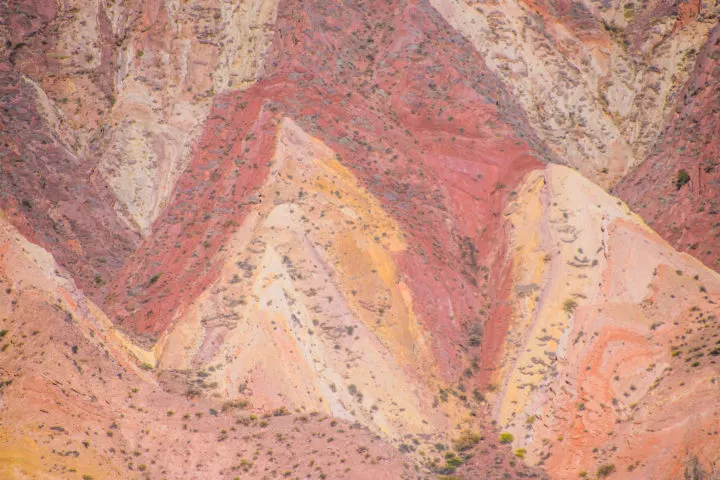
Why the Colors in the Mountains?
You may be wondering, how on earth are the hills here so colorful?! I’ll give you a brief idea from my tour guide: *Clears throat in a super official way and starts speaking in David Attenborough’s voice* Eh-Hem.
Well, millions of years ago, this region was actually underwater. That’s right, it was under the actual ocean, which is crazy to think about now that it’s over 2000m in elevation. They have actually found fossils of seashells here, and many of the white landscapes actually come from shells.
Anyway, you’ll see tons of colors in the hills here as if they have been painted. All these colors come from a higher concentration of different minerals. Yellowish color comes mostly from sulfur, pink and red come from different concentrations of iron, and green comes from copper.
Quebrada de Humahuaca Tour – Humahuaca Gorge Road Trip Stops
Jujuy City
Jujuy is actually the highest elevation capital in the country at 1250m, and is peculiarly green compared to most places around it! It’s greener than Salta and much greener than the Humahuaca Gorge (as you will see as you drive along it) because humidity from across the country (it actually comes from the Atlantic) tends to land right over Jujuy and dissipate as it hits the more highly elevated Gorge.
Jujuy got its name from being an expression of happiness that the Incas named the valley. Stay with me here, I’m going to try and type-sound it out – it’s something like, ‘wooohoooeeee!’ (can you hear it?!). It’s actually super fun to say.
Jujuy is a large city and the capital of the province. That being said, there’s plenty to do there in the way of museums, parks, and restaurants.
Volcán

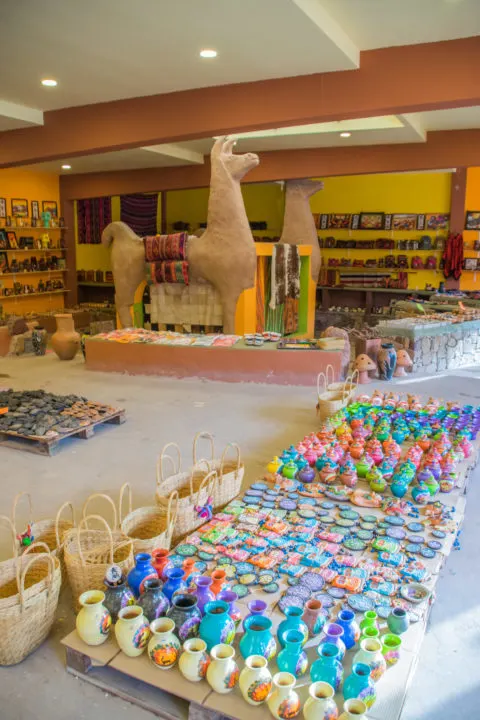


Volcán is a tiny town that would be your first stop in the Humahuaca Gorge. As you climb from Jujuy, you have an immediate 400m elevation gain, and you can literally watch the mountains turn from green to red.
There’s not too much going on in Volcán, but there’s a great Artesanal Market with one of the largest selections of indigenous crafts. It’s also a good first stop for a snack and bathroom break.
Purmamarca + Hill of 7 Colors


The hill of 7 colors is located in Purmamarca, just off the 9 highway. It’s one of the most incredible natural wonders I’ve ever seen! I still struggle to find the words to describe it, but I think the photos should do some justice on that one. Let’s put it this way – I had this place all to myself, while thousands upon thousands of people flock to Rainbow Mountain in Peru. Underrated, much?!
Purmamarca is at 2200m of elevation, with the mountain around it jutting up much higher. I think this is the collectively most colorful point in Northern Argentina, with ribbons of color flowing through all the mountains in the area. The little town or Purmamarca is quaint and lively, with loads of craft markets, accommodations, and restaurants.
Maimara + Painter’s Palate


If you are doing a Quebrada de Humahuaca road trip, make sure to stop here on the way back to Jujuy (or at least in the afternoon) when the afternoon sun shines directly on the mountain, illuminating the colors tenfold.
Maimara is another cute little town, with a picturesque hilltop cemetery overlooking yet another almost impossibly colorful hill. They call this hill the Paleta de Pintor (painter’s palette) because they say that when God was finished painting the world, it was here that he wiped off his hands. I think it’s a totally appropriate story, don’t you?
Tilcara + Pucara de Tilcara

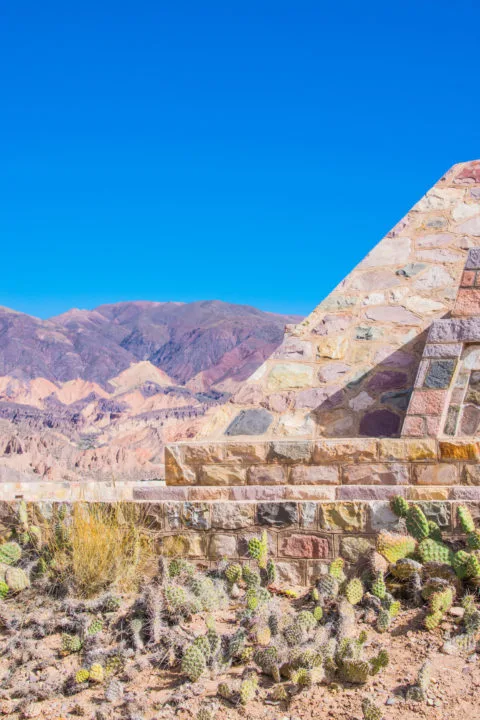


Next up is Tilcara, another (you guessed it) small, colorful, and dusty town. Remember those hilltop forts I told you about before (you didn’t skip the history section, did you?!) Well, Tilcara is home to the only surviving hilltop fortress, or as they are called, Pucará.
The Pucará de Tilcara was actually investigated and restored by the University of Buenos Aires in the 1980’s, and is possible to visit today to learn about what went on there.
Again, these were originally built by pre-hispanic people (the ones who lived here for up to 15,000 years!), were taken over by the Incas in the 1400’s, and then again by the Spanish in the 1500’s. There was visual communication betweenPucarás back in the day, via smoke signals, and ther were used in tons of wars over the years. Crazy stuff, I know.
Today, you can walk through the beautiful cactus-ridden fortress and marvel at the amazing colorful hills, geological formations, and historical temples and sites within the Pucará walls. You can even take a selfie like the guy in the photo above! 😛
Huacalera + Tropic of Capricorn

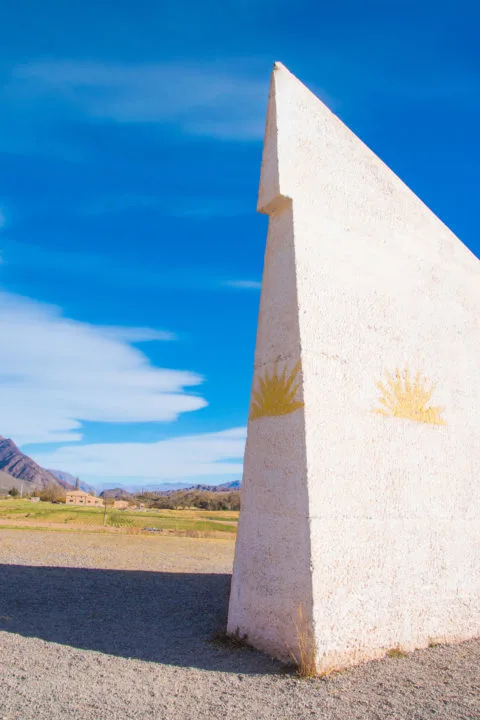

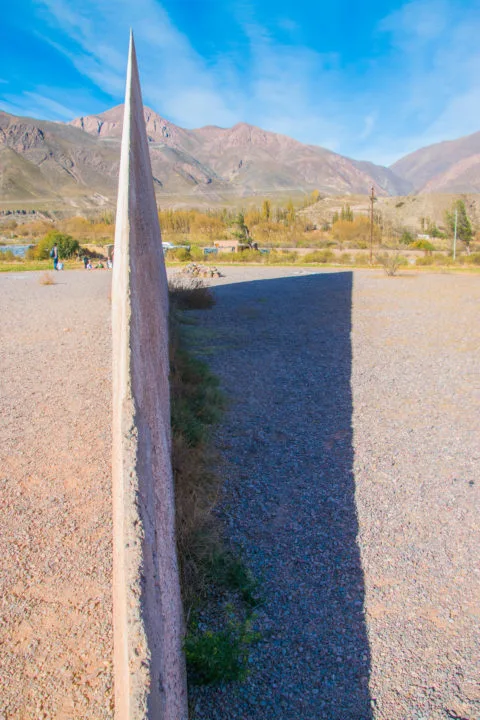

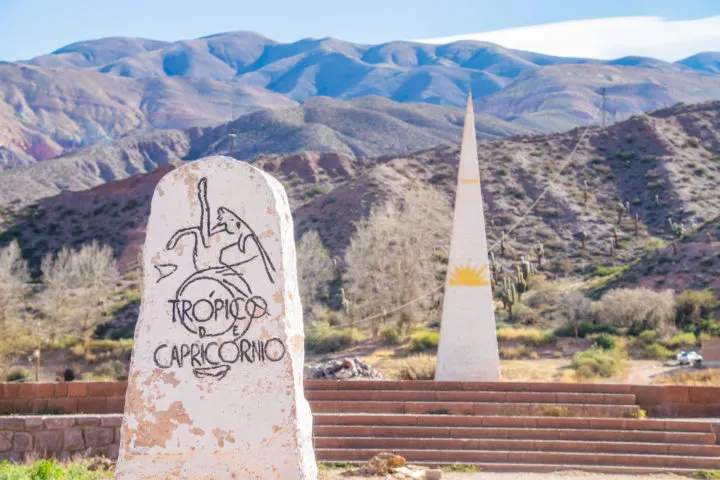
You can actually cross the Tropic of Capricorn right here in Northern Argentina, and another tiny settlement called Huacalera has a massive sundial clock to commemorate it!
This spot has a few craft markets and a huge circle surrounded by colorful hills and farmland, and you can tell the time by the shadow on the ground if you know how to read a sundial.
Uquía + Church of San Francisco de Paula

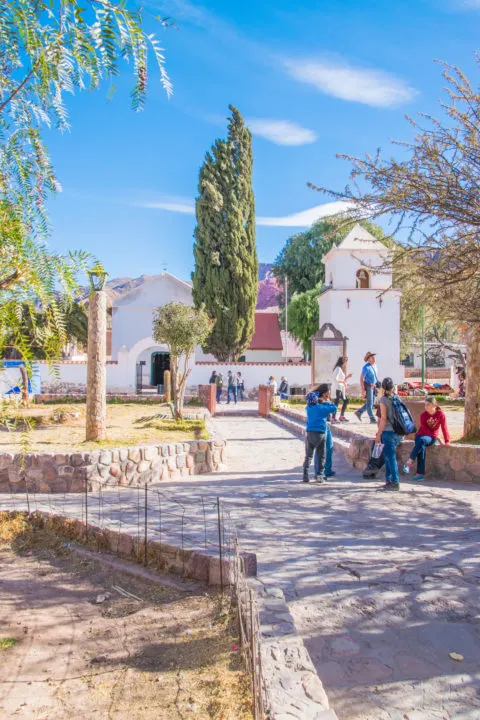

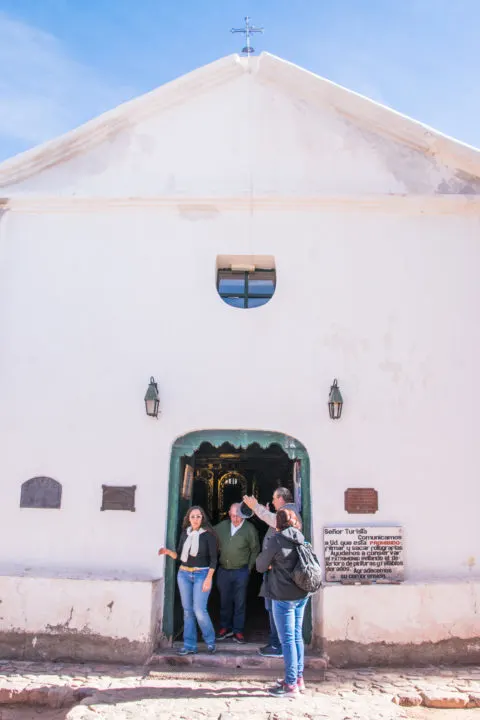
Uquía (another tiny town!) is special for a church you can visit there- but it’s not just any church. This church was built in in 1691 during the Spanish inquisition, and is known for some absolutely fascinating art inside. Bear with me here – I’m not usually one for art but I find this story fascinating!
So, during their rule, the Spanish used to send indigenous people to Cuzco to study art, and these people would have various jobs when they returned. Cuzco was much more Catholic, while the Humahuaca Gorge was still a big mix between indigenous religions and Catholicism.
Legend has it that when these indigenous peoples were sent to learn in Cuzco, they saw all the Catholic texts and art and (probably among other questions) asked what angels were. It was explained to them that Angels were ‘God’s soldiers, like people but with wings.’
So, these people came back to the Quebrada de Humahuaca to do their art projects, and painted Angels just like they had heard: Like humans (wearing traditional clothing of the time) with wings (but, with wings that they knew from birds they had seen) and with guns, because they were ‘God’s soldiers.’
Unfortunately, photos were not allowed inside the church, so I can’t show you what these ‘angel soldiers’ looked like. I guess you’ll just have to go and see for yourself!
Clay Pottery of the Quebrada de Humahuaca Tour

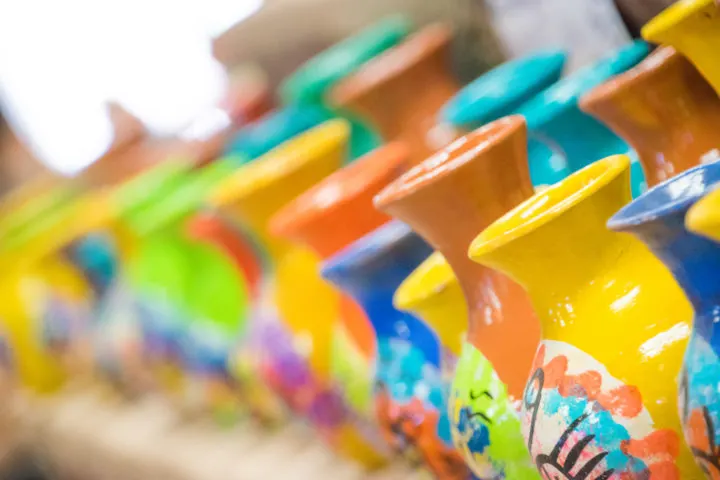


Somewhere between Uquía and Humahuaca, you’ll pass by a massive llama statue (and perhaps some live llamas in front) where they have all sorts of local pottery. We stopped here on my tour, and I couldn’t be happier we did! Pottery, along with agriculture and minerals/mining, is a main source of income around these parts.
Clay is abundant in the area from mountains and rivers. Over the years, locals learned to be very skilled in every kind of clay work imaginable. We got to see a clay worker expertly molding cups, bowls, and vases in a matter of seconds, and also the molds they use to make traditional Inca masks.
If you’re looking for a traditional souvenir from this area, this is it. They have a huge shop with every clay thing imaginable, along with much more. If you haven’t been tempted to spend money yet, good luck getting through this shop!
Humahuaca


And now, we have made it to the northernmost point of the Humahuaca Gorge that I made it to. You can go farther if you want, but Humahuaca is a great town to stop, explore, and get some traditional lunch.
Humahuaca is known for its long, thin, and colorful streets, which are often lined with vendors selling even more traditional crafts. This day would be a great one to buy souvenirs if you are thinking of getting them (I was bummed I didn’t, to be honest!)
Here in Humahuaca, you can get a traditional Argentine soup, a locro, milanesas (schnitzels) of chicken, beef, or even llama, or empanadas of every possible type. We had a ground meal before heading off to explore the town, climb a huge central memorial, and shop for more crafts.
If you’re driving a rental car, make sure to save some stops (especially the Painter’s Palate) for the way back to Jujuy. Either wat, I hope you enjoy, get great photos, and appreciate the history and culture of the Quebrada de Humahuaca.
Salinas Grandes


Most tours also visit the Salinas Grandes after the Humahuaca Gorge – Northern Agentina’s own beautiful salt flats! This area is actively extracted for saly to this day, so it may look different depending on when you visit.
One thing that is for sure is that you’ll be able to take fun photos out in the salt flats and see some beautiful salty pools, too!
Well, I hope you have enjoyed the Humahuaca Gorge tour! If you’d like to book this tour for yourself, click here to book Quebrada de Humahuaca Tour I did.

Planning on visiting Jujuy or the Quebrada de Humahuaca? Pin this!

Passionate, full-time travel blogger with over 230k on social media and 150kMPV blog. Extraordinary photographer with two DSLR's + a drone with a love for capturing candid moments, epic drone shots, and magical compositions. I'm a natural-born content creator originally from California, but I've been on the road for 9 years living, working, traveling, blogging, and photographing my way around the world. I recommend the most amazingly adventurous and unique + boutique travel experiences/stays and helpful products to my audience and write comprehensive guides on my website that have helped millions of travelers so far. I love to inspire people to plan their dream trips, and many readers have given feedback as such. The reach on my platforms continues to soar, especially when combining cutting-edge social content with optimized articles on my high-authority website.
Guide to Visiting Northern Argentina: What to See in Salta and Jujuy
Thursday 9th of August 2018
[…] Read my Post About the Humahuaca Gorge Here or View the Tour I Did Here […]
Daisy Altelaar
Monday 6th of August 2018
Wooow those rainbow mountains look unreal! I didn't know the north of Argentina is this beautiful! I had to choose between the North of Argentina and Chile when I was there two years ago (I picked Chile) and am happy to find this place as a reason to go back.
KimmConn
Wednesday 8th of August 2018
Yeah, I honestly had no idea either!! So glad to give you a reason to go back, it's honestly INCREDIBLE!
Glo
Saturday 4th of August 2018
Argentina is full of so many gems! This reminds me of my trip there in February. We covered so much ground and I got Bolivian vibes as well. Awesome photos!
Salta Road Trip: Route 51 from Salta to San Antonio de Los Cobres
Thursday 2nd of August 2018
[…] READQuebrada de Humahuaca Tour - Humahuaca Gorge Road Trip with Daytours4UPowered by Inline Related Posts […]