
Part 1: My Experience Traveling to Vietnam as an American Veteran’s Daughter in Hanoi/Northern Vietnam
My dad told me that it would be a very different experience traveling Vietnam and seeing museums, memorabilia, and historical sites from the Vietnam War, or the “American War” as they call it here. He told me it would be biased and that they would have a different perspective on the war than we have over here.
I believed him, but nothing could have prepared me for what it was really like here, and for the ways in which they framed the Americans and themselves.
Having a father who participated directly in the war gave me a unique perspective taking in all the war information here. They treat it like such an aggressive crime against Americans in general, which it was in some ways, but I know first hand how inevitable it was for some people.
The war has been over for over 40 years, and I would have thought that the people and culture would have been largely past it by now. But that is sadly not the case at all. The “American War” is something that is deep rooted in the identity of Vietnam and the lives of its people to this very day. Its effects are lasting and far-reaching. This war literally defines Vietnam. Everywhere you go people talk about the effects of the War on that area, and in each city there are different ways in which that part of the country was affected.
I took the information in differently as I moved through Vietnam from the north to south, especially after being blatantly victimized by war propaganda in Hanoi that is being broadcasted to tourists to this very day. Here are my experiences in different Vietnamese cities and my reactions to their portrayals of the “American War.”

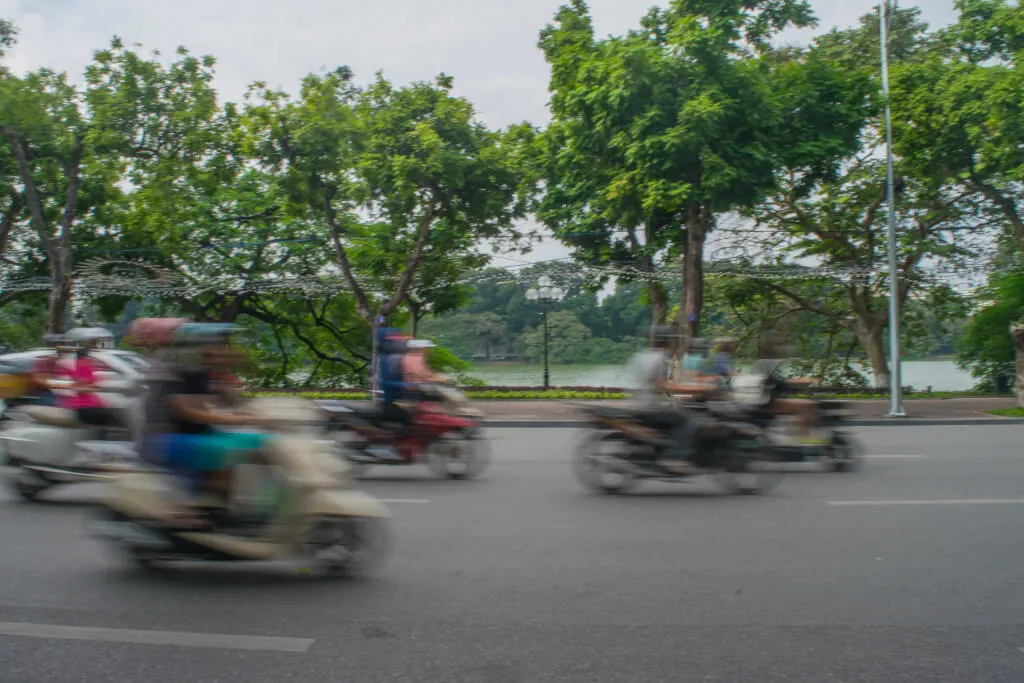

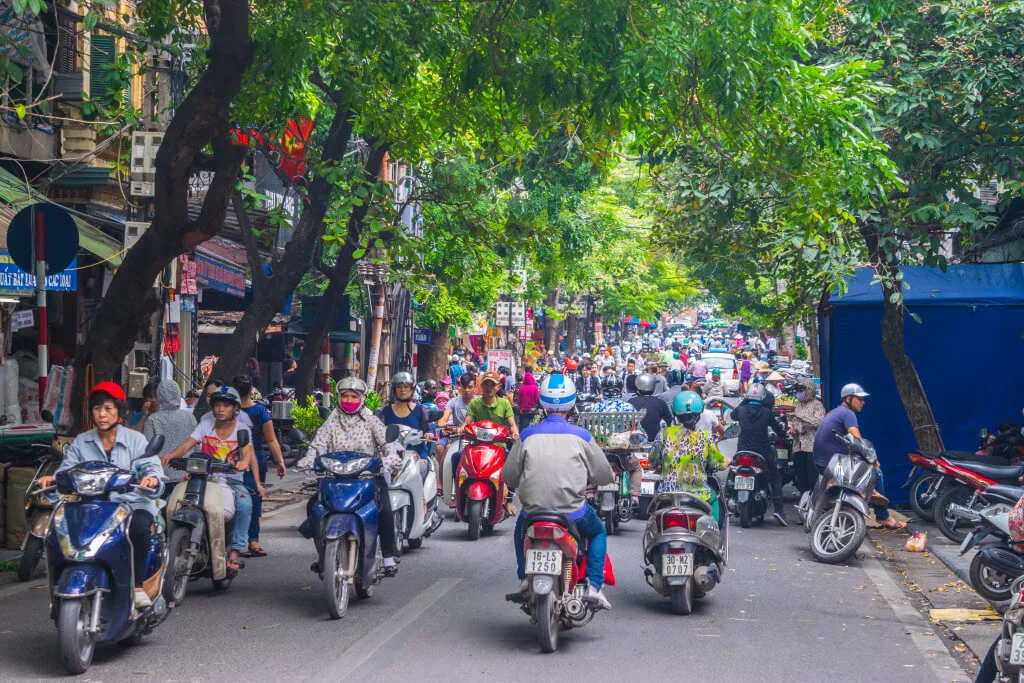
Hanoi
When we got to Hanoi there was a prison that had been converted to a museum. It first housed Vietnamese political prisoners during the French colonization in the 40’s and 50’s, and was also used to keep American pilot prisoners of war during the “American War,’ as they call it. Hanoi is in North Vietnam, the side that was trying to take over the south side which was assisted by the US. So, as I was traveling from north to south, this part of the country would generally be more hostile against Americans of the two.
Read More: Hanoi Travel Tips for a few more non war-related activities and book travel and transfers in Vietnam in advance
The part of the museum about how the French treated the Vietnamese was absolutely shocking. Hundreds of people shackled in small rooms, a section for women, a guillotine, and an absolutely inhumane room where they would keep people who disobeyed the prison’s rules; here prisoners would remain shackled by their ankles on a downhill slope and were forced to eat, drink, and relieve themselves right in that same place.

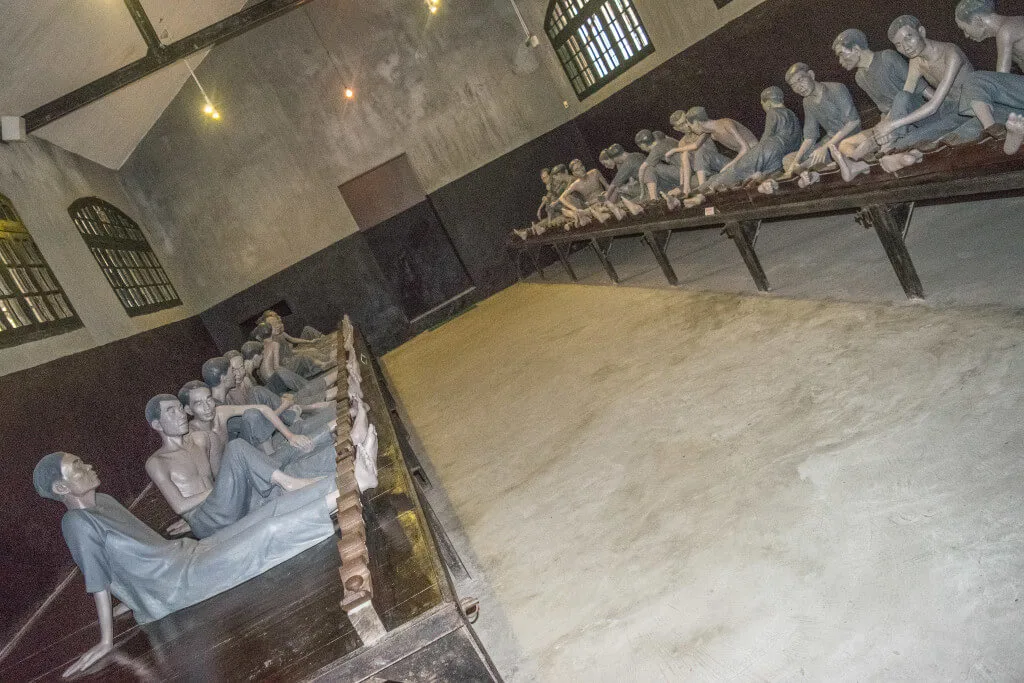
It was hard to believe how awfully humans could treat each other, and also the stories of perseverance noting that the Vietnamese still secretly studied communism and furthered their regime while imprisoned. Some even escaped through a sewage drain.
Since my father was a cargo pilot during the war, a lieutenant colonel, I was more keen to check out the pilot exhibit I knew they had here. The American section of the prison began with tons of posters depicting protests all over the world against the war – Russia, China, Italy, England, Australia, even protests all over the US itself. There were photos of mothers throwing away medals of their sons that they had lost, which was especially heartbreaking given the controversial status of this war and the fact that could well have been my grandmother.
The beginning of the pilot exhibit came up, and there were posters on the wall about how well they treated the Americans and all the amenities they were given in prison, or the “Hanoi Hilton” as they called it.
I wandered through the first room to see photos of planes being shot down, and photos of miserable looking American pilots all stockpiled into a book of men who had been imprisoned there. It gave me chills to think about the fact that I may not be here writing this today if my dad had been in one of those photos – which could have been anyone really.
- Read More: How to Get from Hanoi to Sapa, another beautiful destination nearby!
- Read about doing a Ha Long Bay Cruise on the coast
My dad wasn’t a fighter/bomber pilot; he flew mostly C-7 Caribou’s to bring supplies and cargo to bases all over Vietnam. This plane was special because it was designed to take off and land on tiny little makeshift runways, some as short as 900ft, in the middle of dense jungles. How scary is that?! Being a cargo pilot doesn’t mean it was particularly less dangerous, however. The planes he flew were extremely slow so that they could manage to carry heavy weight and also take off and land on these short runways. This basically made him a sitting duck to opposing forces trying to shoot planes down going around the country. He had some really scary experiences getting shot at, having to descend to fly at 200ft to get out of dense fog, and losing all navigation and communication capability while water leaked into the cockpit in a rainstorm. I literally cannot imagine how scary some of these situations would have been, and how, at the time, he wasn’t much older than I am now.
I continued to wander through the exhibit. There were photos of towns and cities leveled by bombs dropped by B-52 fighter jets, and mangled pieces of what apparently used to belong to an airplane. John McCain was a POW here, and his forest green colored flight suit was on display in a glass case. I’m sure my dad wore something similar.
I looked at the items each POW was shown to have used while in the prison – there were packs of cigarettes, toothbrushes, plates, bowls, cups, hand lotion, throat lozenges, towels, button-up shirts, sweaters. I was already very surprised how much more the American prisoners seemed to have than what was shown for the Vietnamese during their imprisonment by the French.
Impressed, I moved on to the next room. There were photos of Bill Clinton, George Bush, and John McCain in Vietnam shaking hands with someone or another, some at the prison itself. There were photos of buildings that had been rebuilt after being leveled by bombs. There were photos of leather shoes and tote bags that prisoners were apparently given upon their release, and photos of prisoners lining up to leave the prison or upon their arrival back into the US.
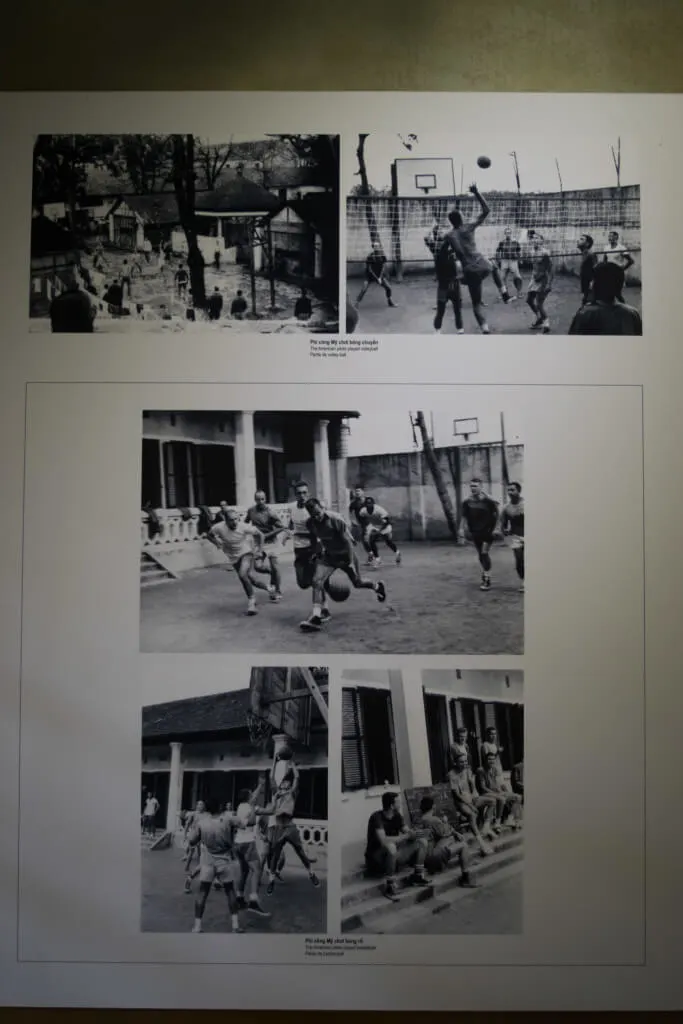
Moving along, we saw a Christmas drawing that some prisoners had apparently drawn while in captivity, of Santa and a sleigh. There were photos of the American prisoners doing all sorts of things – it said they they were shown a film to learn Vietnamese culture, that they could own pets if they wanted to, or farm their own vegetables to look after. There were photos of them doing all kinds of sports – massive volleyball games in the courtyard, soccer, basketball. Captions said that their private time was always respected, that they were able to write and receive letters and packages from home, and they they were able to have a Christmas tree during the holidays and even go to a Christian Church.
“How could this all be true?!” I thought, somewhere between being in disbelief, surprised, impressed, skeptical, and almost thankful in a way they they seemed to have been treated so well. My dad was of course not a POW, and doesn’t tend to talk much about the war, so I didn’t previously know much about how they were treated. But here there were photos, even videos of them playing board games, playing guitar, reading, being active, keeping busy, and almost even looking sometimes like they were enjoying themselves. As prisoners of war?!


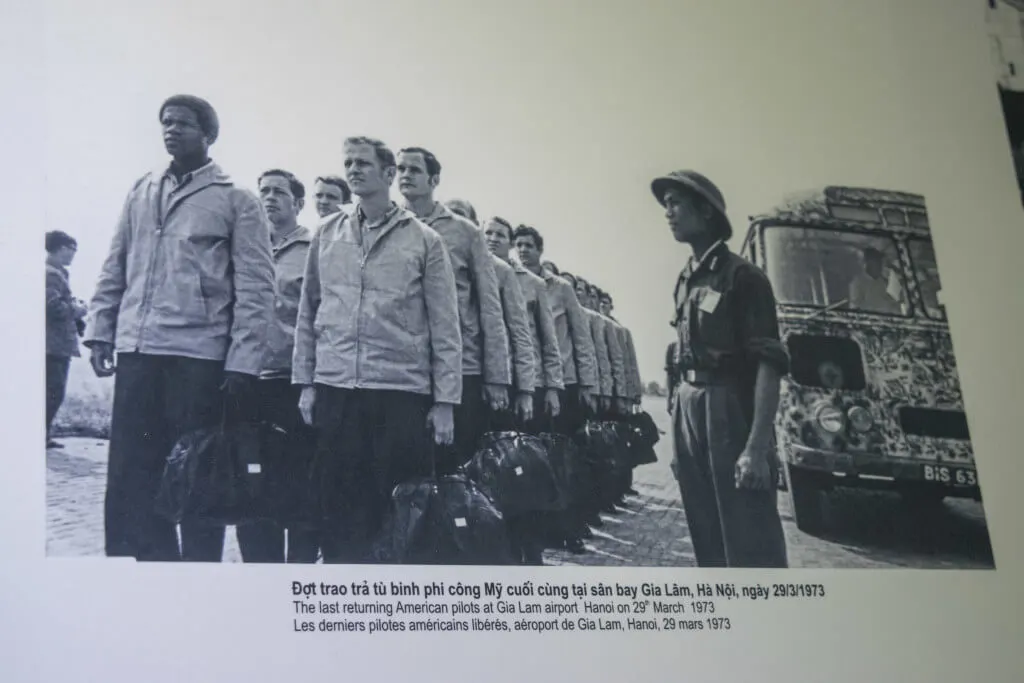
I wandered over to a video screen playing a subtitled film reel. It went on and on about how well the Americans were treated here, and how lucky they were to have been prisoners of the Vietnamese, I suppose as opposed to another country. It talked about how the prison keepers were able to make the Americans see through their imprisonment that they were doing wrong by bombing their innocent country for an unjust war, and that all of them left feeling changed and that they could basically understand their wrongdoing.
Thinking this was a nice happy ending, and feeling pretty taken aback by the apparent display of graciousness I had just seen, I left the prison. It took some time to process all this. Soccer? Board games? In prison? How is it possible there was such a contrast from the torture rooms and execution chambers of the Vietnamese under the French, and then the happy freedom of the Americans?
Since this was an especially relevant museum visit given the American pilot exhibit in the country my dad fought, I snapchatted the whole thing so my parents could see it. I let them know to check my snapchat out (@kimmconn), went and got some pho, and went on with my day.
The next day I woke up to a text from my dad.
“Hey Kim. You were victimized by Vietnamese propaganda,” he said. “I don’t know how the French treated their POW’s. But I’m absolutely (100%) sure that American POW’s were all repeatedly tortured and brutalized by the North Vietnamese.”
“WHAT?” I felt confused and pretty violated to be honest. What the hell?
He went on to say that they were not only treated badly, but many suffered malnutrition due to bad food. He said the Vietnamese wouldn’t even tell the US government if the POW’s were in captivity, leading their families not to even know if they were dead, alive, MIA, or prisoners of war.
There were no board games. No guitars. No christian churches. No packages being sent home. No nothing.
The photos I saw in that prison were taken as propaganda to convince the world that the Vietnamese were taking great care of the POW’s, and that the Americans were the real barbarians. And, to this day, they are still doing that to dozens of visitors in that prison each day.
I was so taken aback. I had just wandered through that prison museum, so unassuming, innocent, and eager for understanding that I had just passively taken that information in and spread it to others. I mean sure, I was slightly skeptical and very surprised that they were apparently treated with so much care, especially after going through the first part of the prison with all the torture chambers that I had first assumed to house Americans too. Which they probably did. But I will never know, because of this false idea of righteousness that is being put forth each and every day.
I felt so cheated to have been blatantly lied to in this museum. I knew that visiting Vietnam would present an entirely different bias to that war than I am used to at home, but I wasn’t expecting that. I was expecting some bad views of Americans and framing war memorabilia to make Americans look bad. But I didn’t expect to witness something twisted so dramatically to make the Vietnamese look like they had done nothing wrong. Here, in 2015, propaganda is still being fed to the masses, of which I was one.
From here on out, I was skeptical, chose what to believe, and took everything with multiple grains of salt.

Passionate, full-time travel blogger with over 230k on social media and 150kMPV blog. Extraordinary photographer with two DSLR's + a drone with a love for capturing candid moments, epic drone shots, and magical compositions. I'm a natural-born content creator originally from California, but I've been on the road for 9 years living, working, traveling, blogging, and photographing my way around the world. I recommend the most amazingly adventurous and unique + boutique travel experiences/stays and helpful products to my audience and write comprehensive guides on my website that have helped millions of travelers so far. I love to inspire people to plan their dream trips, and many readers have given feedback as such. The reach on my platforms continues to soar, especially when combining cutting-edge social content with optimized articles on my high-authority website.