
This is part three. CLICK HERE to start from the beginning.
We had always known that Ho Chi Minh City, known during the war as Saigon, was where the biggest war museum (War Remnants Museum) and the largest visitable tunnel system (Cu Chi Tunnels) were. So we set out to see the last War sights in our last stop in Vietnam.
Ho Chi Minh City
The War Remnants Museum in Ho Chi Minh City is one of its main tourist attractions, and has three floors full of exhibits about the American War and some seized planes, tanks, and other artillery. This museum had some parts that were biased and some that seemed pretty straightforward or objective – it is often so hard to tell when you’re backpacking to Ho Chi Minh and trying to tell fact from fiction.

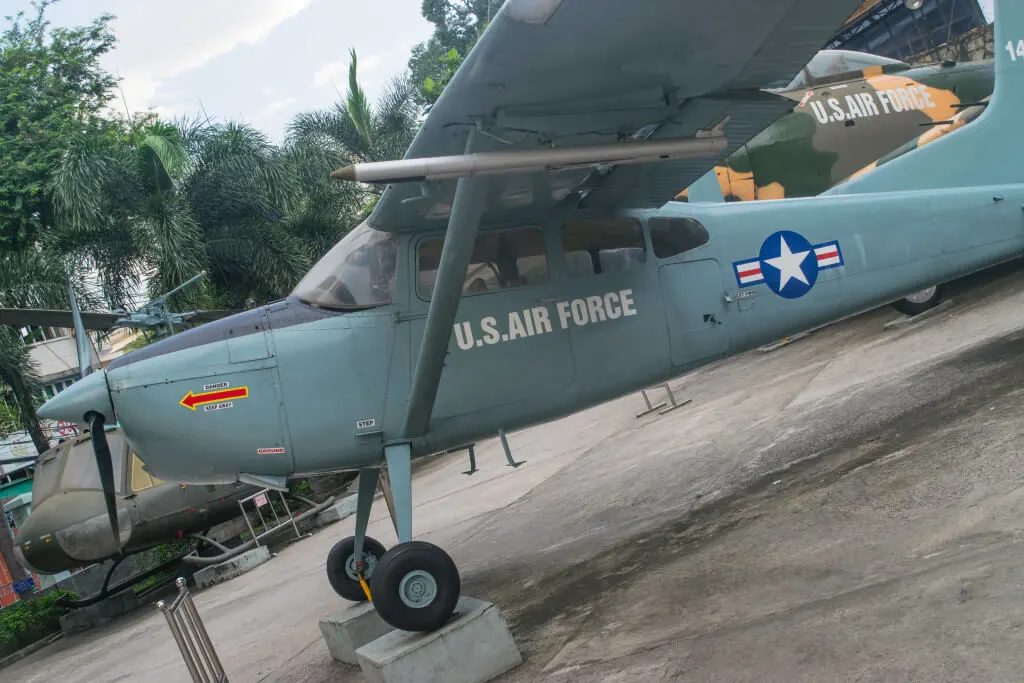
The museum began with your classic protest photos – of protests against the war from all over the world. There were signs about “supporting Vietnam in its resistance” to America and other things like that, naturally making it seem that the US was barbarically invading the country for no reason. There was a lot of documentation about other countries putting efforts together to help the Vietnamese and send them supplies and things in their time of need.
The next part was all about war crimes. This, from my understanding, was the most biased and exaggerated part of the museum. This is where they really went out of their way to make America look inhumane. And yes, the US did some inhumane things during this period. So did the Vietnamese. War is just messed up in general – it brings out the absolute worst in humanity and it really is disgusting.
But anyway, this exhibit was the hardest to go through. Vague photos that could have been anything really were given captions to make all the situations into times where the US was being barbaric, killing women and children because they enjoyed it, or killing people for no reason. One of the first photos was of a little girl crying, and the caption was, ‘a child cried out, “don’t kill my father” as American soldiers dragged him from their house.’
This is where things get hard. Could that have actually been the situation? How could they know from the photo that that is what was happening? Could they be overly dramatizing it just a little bit? Or a lot?
There’s no way to know.
The exhibit went on to talk about all war crimes and atrocities. Apparent pictures of Americans pushing prisoners out of helicopters and shuffling families out of their homes. All looking like they were doing it out of pure cruel intention.

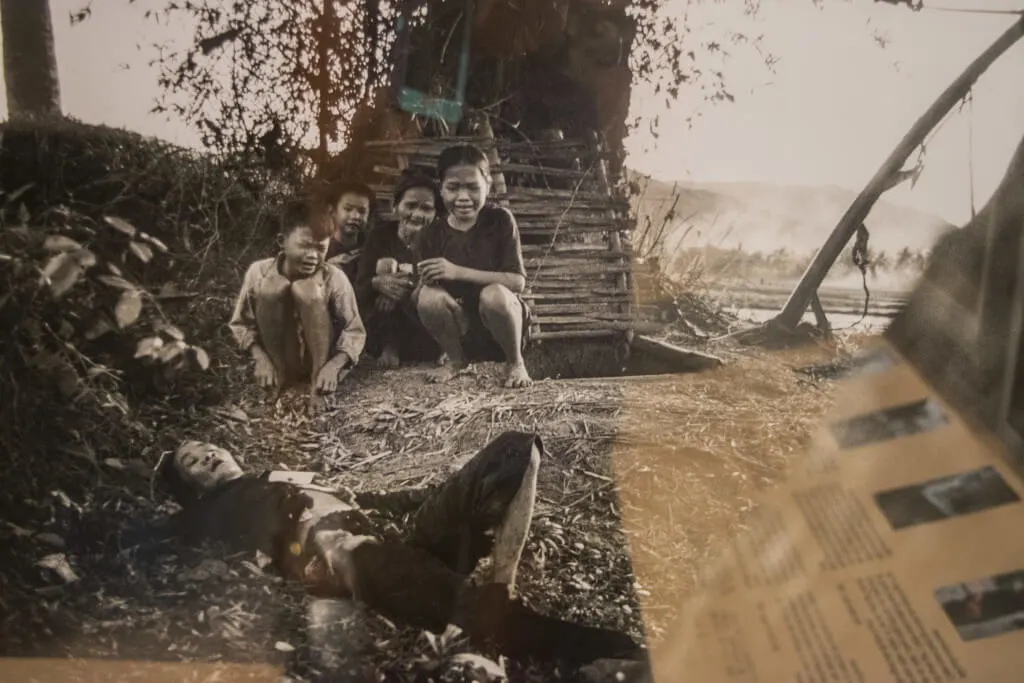
The worst were in-depth catalogs of extreme atrocities apparently committed by Americans – on “burn all, destroy all, kill all” missions, or so they called them in the museum. Of Americans going through entire towns and just leveling them to the ground, killing people in murderous ways and disemboweling them.
I thought of my dad telling me about how he and his squadron went and delivered Christmas presents to Vietnamese children while he was deployed. Could the same soldiers do something so awful?
I also thought of how he told me ground troops could never even tell who the enemy was – Viet Cong would infiltrate towns in Southern Vietnam who were supposed to be helping the US. They would requite villages to provide fighters and food on the threat of death. People would be farmers by day, and killers by night. They would even send women and children to distract or bomb troops, or work on their behalf. He said it was so hard because you could never tell who the enemy was- they had no uniform or way of identification.
Could a frustration like this really lead people to such inhumane deeds? Apparently so. War, again – terrifying.
The next exhibit was about Agent Orange, and was absolutely heartbreaking. Again, Agent Orange was a substance planes would drop onto the Vietnamese jungle with the intent to kill the foliage and expose soldiers and roads being constructed. However, this substance actually killed/harmed people and all living things, made land unfarmable, and left lasting deformations in exposed people’s DNA so that their children would be deformed as well.
Glass boxes full of gas masks and bombs filled the room – even some literal deformed babies sitting in liquid preservation containers. Photos of awfully deformed people covered all the walls – some without limbs or body parts, with bones, skin, and lumps going every which way – with their names and hometowns and some info listed under each photo.
It was really hard to look at.
But I felt like I had to – to come to terms with an outcome that is a reality of the Vietnam War.
There were so many facts. It said that dioxin, a main component of Agent Orange, is actually one of the most poisonous and toxic substances ever to be discovered by man to date. It said that 100 million liters of it affected 2-5 million Vietnamese people.
Two. to Five. Million.
It said that 10% of exposed Australian veterans were so seriously affected that their spouses had miscarriages and 1/4 of their children had birth defects.
It said that 85g of dioxin could kill a whole city of 8 million people.
It said thousands of American veterans filed lawsuits against the suppliers of Agent Orange to the US armed forces.
There were newspaper clippings about Vietnamese people trying to claim compensation for Agent Orange’s effects, and the US not providing any.
Like basically everything, I don’t know the truth in these facts. But I do know that it’s some serious stuff. Some serious stuff they sure as hell didn’t teach us about in school.
The next exhibit was my favorite – a war photography exhibit. It presented a great compilation of hundreds of photos taken by any and all photographers in Vietnam during the war – American, Vietnamese, French, British, Japanese… anyone. This nicely weaved together a much more objective, or multi-sided view of the war. It was pretty incredible how brave these photographers were – I would say most of them ended up being killed in some way before even returning to their home countries. It was crazy to read captions like ‘ this was the last photo of so-and-so before he stepped on a land mine killing him on the spot.’
This section had all sorts of battle and lifestyle photos of soldiers in their everyday lives. A few photos that stuck out to me –
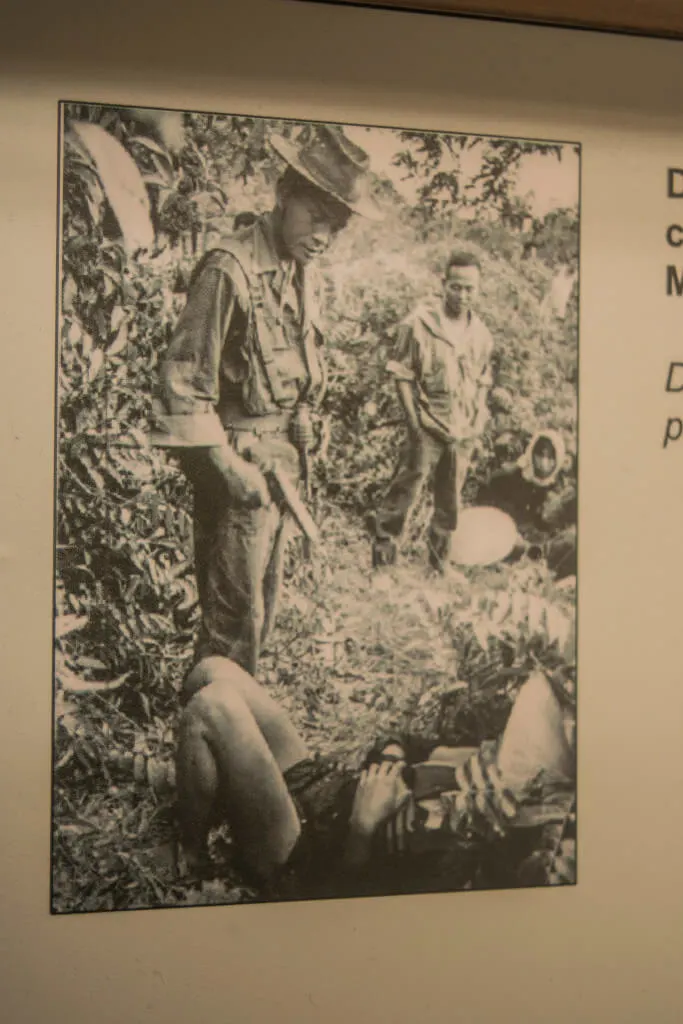
- A photo of a Southern Vietnamese soldier standing over a Viet Cong soldier with a gun, about to kill him. It is often not even acknowledged that there were Southern Vietnamese soldiers fighting against the north… it is often framed like it was basically just America vs. Vietnam. So this was a good reality check that it was a civil war before the US came in!
- A photo of a C-7 Caribou being shot down. This was the plane my dad flew so it especially hit home.
- Kimmie’s deep thoughts while in museum
- A photo of a Vietnamese family crying and holding each other, with a wounded mother laying in the foreground and war carnage in the background. Pictures really are worth 1000 words – I simply cannot imagine the hell these people went through.
- Photos of people killed by American soldiers. Photos of dead people will always stick in your mind and make it real to you what happened.
- A photo of the VC driving Russian-made tanks and trucks with Russian weapons. I find it so interesting what lack of mention there is about the assistance Northern Vietnam received from Russia and China. The only place in the museum that actually depicted anything about Russia was this photography exhibit – which I found to be the most objective War documentation in basically the whole country.
- Apparently (and rightfully so) one of the most famous photos from that generation – a photo of about six or seven children, some naked and all terrified or crying – along with some US soldiers all running visibly quickly down a road with an immense explosion in the background. This photo is just charged with so much emotion. You can almost feel their terror – I saved it so you can see for yourself.

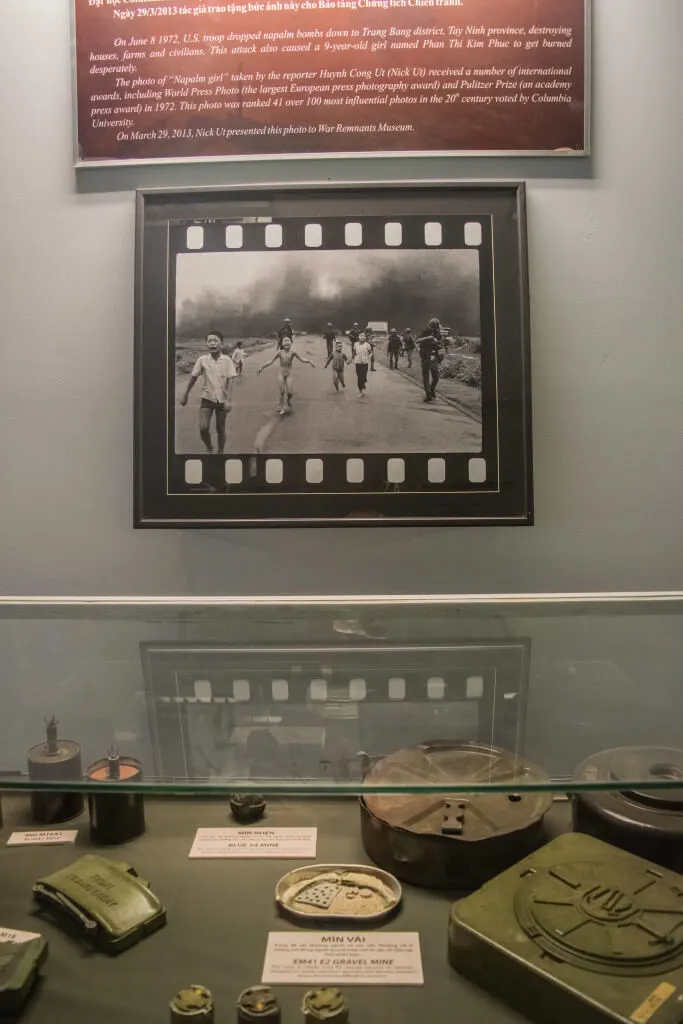


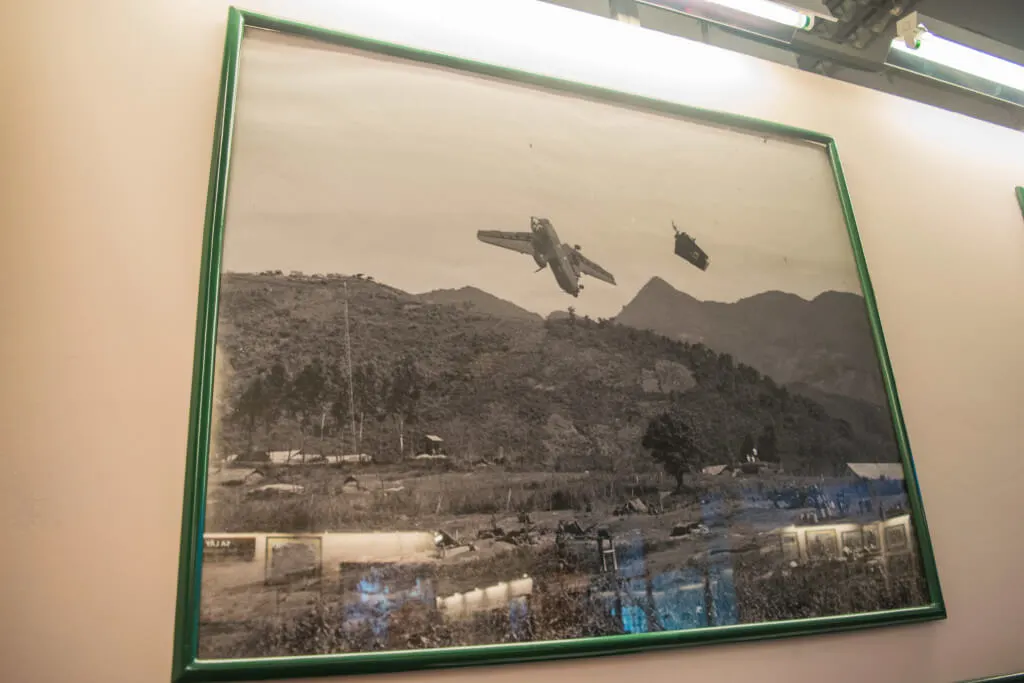
The whole exhibit was dotted with glass cases of bombs, guns, rocket launchers, and pieces of things that exploded. The combination of everything was very intense, especially being into photography myself. It was a lot to take in, and very emotionally charged, but really good.
I could tell why the mere fact of having journalists there reporting the Vietnam War caused so much trouble throughout the world. This was the first War that was able to be televised as technology grew in the late 60’s. This caused people to resent the War more and more because they could actually visualize the obscenities that were occurring. Many of these photos could have been part of the reason the US pulled out of the war – they were so intense they caused everyone to be against the War and the soldiers in it. I guess that’s what happens when the public is able to understand what goes on during war for the first time.
The last exhibit was more of a historical one outlining Vietnam’s warring with the French before even their Civil War or America’s occupation began. I had to take a little while to let all the experiences from this day sink it- it was definitely a lot.
Cu Chi Tunnels
My neighbor, great family friend, and basically my second dad, Steve, was stationed at Cu Chi during the war, which again made this visit especially close to home.
The tunnels are about two hours outside the city, and are essentially a multi-level network of underground tunnels that the Viet Cong lived in and used to ambush American troops in a town called Cu Chi. These tunnels had tiny entrances about the size of my laptop (literally – and I have a 13 inch one) every 50-70 meters, air holes every 30 meters, stretched hundreds and hundreds of meters all over southern Vietnam, and were (literally) half a meter wide and just about one meter tall.
Yes, those measurements are correct. 1/2 meter wide and 1 meter tall. The Viet Cong used their small size to their advantage during the war and quite literally scurried about in a permanent squat underground, waiting for their time to ambush soldiers from literally any point. They would never use the same entrance two days in a row. Can you imagine that?! I walked through the jungle and looked at these underground mecca’s of tunnels, and thought of Steve, at 20 years old, scared half to death knowing the Viet Cong soldiers could pop up anywhere at any minute.
No matter which side you’re on, that is absolutely terrifying. He was drafted into the war, just a young boy. The Viet Cong guerrillas were very smart as well, surely also just young boys fighting the only way they knew how against their more highly equipped enemy.
But let’s back up a second.
The way they portray these tunnels is very different than I just described. On the way to Cu Chi, there was a film played on our bus to give you a small ‘briefing’ on the site. Although now very familiar with and ready for anti-American biases, this film made my jaw fall to the floor. During the first five minutes, the whole bus was told about the “Cruel Americans” who descended on this small, beautiful town with all of its innocent, smiling children, for apparently no reason at all. These cruel Americans also, and I quote, ‘targeted women and children.’
Sure, film, I’m sure their presence in Cu Chi had nothing to do with the fact that the Viet Cong had a huge underground tunnel metropolis that had in fact been started during the French occupation.
The video went on to describe the valiant and strong Viet Cong guerrilla soldiers who ‘made booby traps that could catch a US soldier at any time,’ and talked about a specific soldier who ’alone killed hundreds of American soldiers’ as if he was a darn hero. It told us that they lived underground because the “Americans wanted to turn this beautiful place into a death land,’ and that the VC had an oath with each other called the ‘circle of destroying Americans.’
I’m not even kidding that it said all of this. Again I thought of Steve. Surely people don’t believe all this?
A few of the other travelers, knowing we were American, nervously glanced over at us during this part of the film to see how we were taking it. It really was that brutal.
Getting to the tunnels, we got to see a tunnel entrance first – which really was the size of my laptop. Only the smaller people and girls could even fit inside!

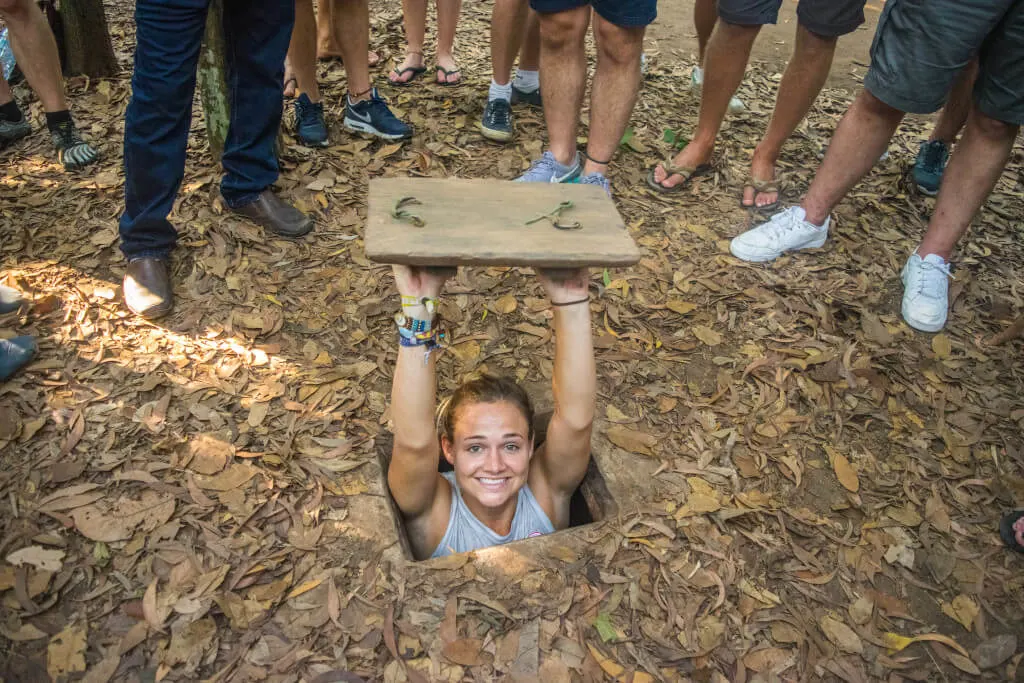

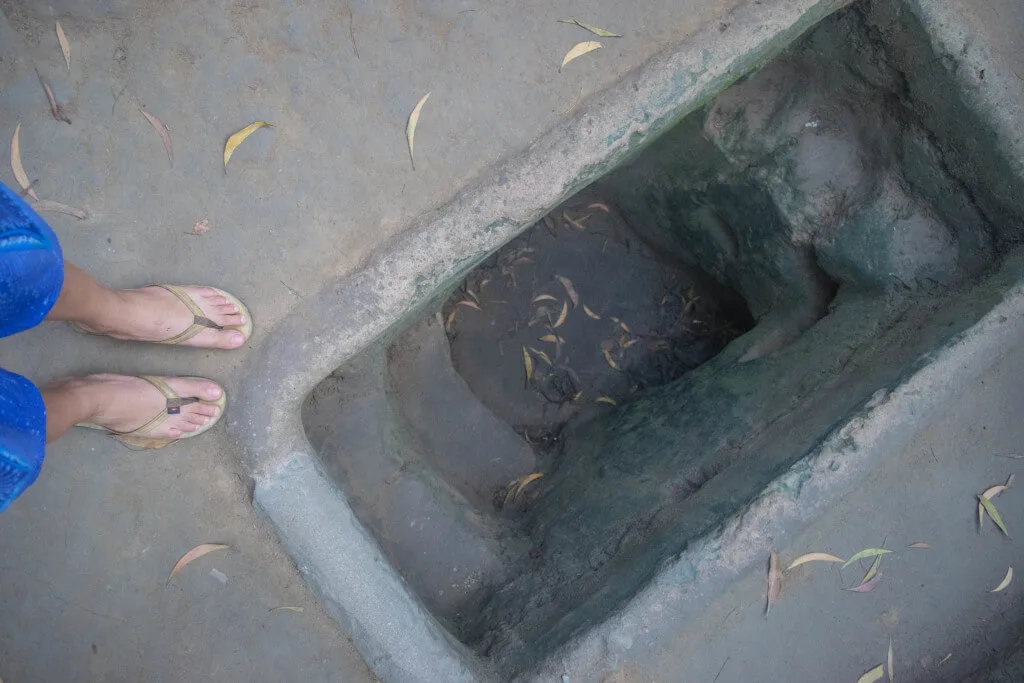
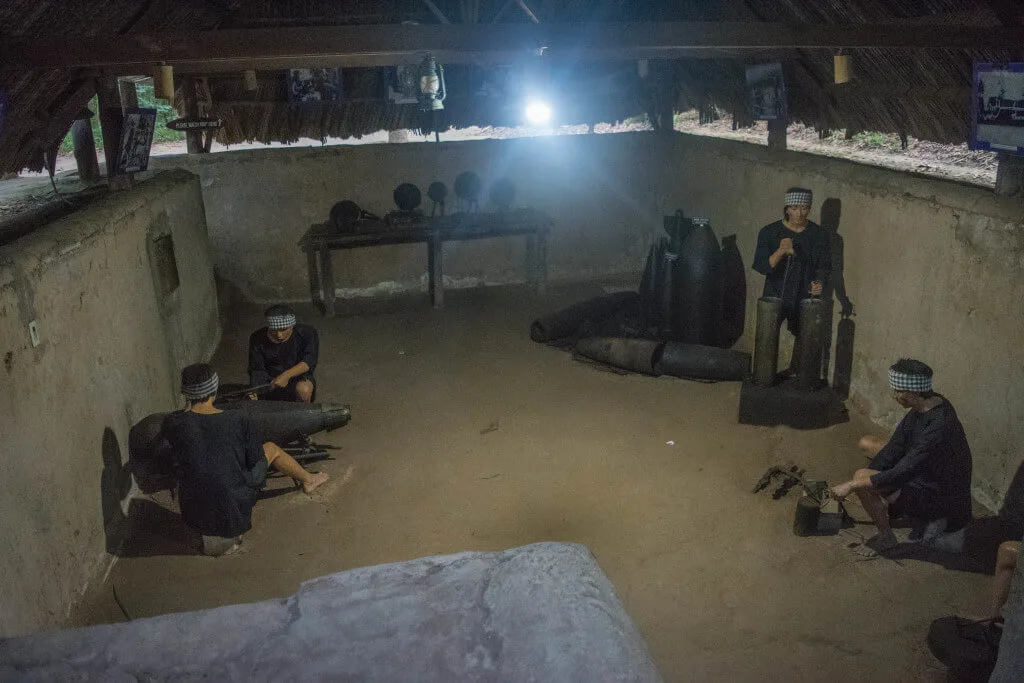
We saw some replicas of VC camps and where they would take shrapnel from american bombs and remake them into their own bombs and booby traps. the booby traps were absolutely TERRIFYING.
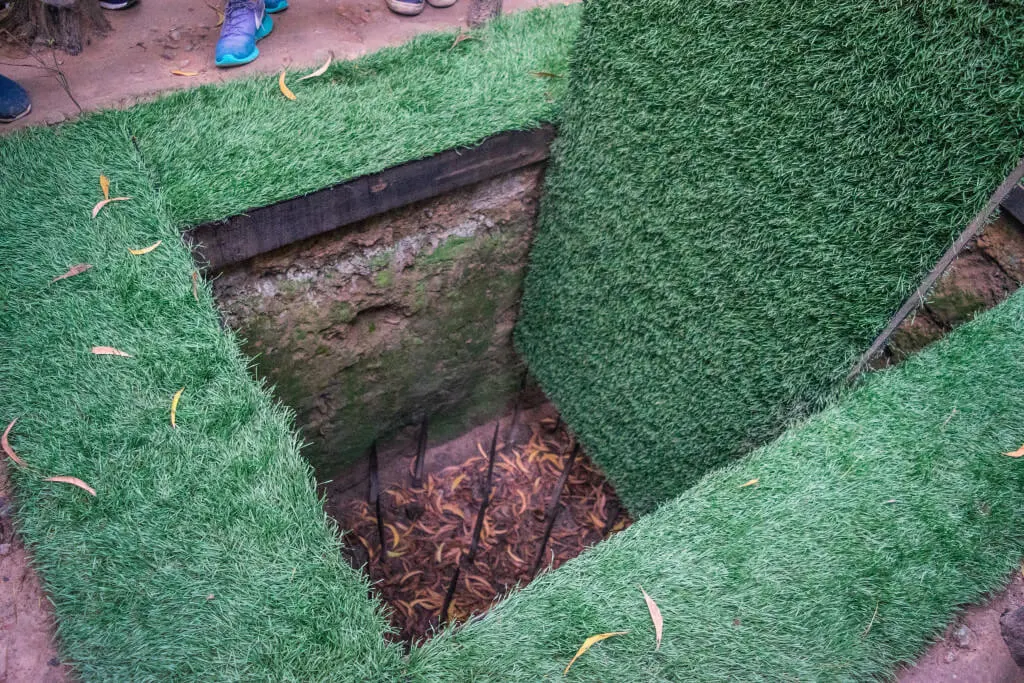
Most of them revolved around a hole dug in the ground, with all sorts of different ways constructed to torture and impale anyone who was unlucky enough to step on one. One was a revolving door with 3 foot metal and bamboo spikes underneath it. One had tons of metal spikes pointed slightly downward so if your leg got caught in it it wouldn’t be able to come out. One involved two metal clamps with spikes that would impale your leg if you stepped on it. One was a swinging metal spike that would hang from a tree and swing at anyone who stepped on a certain spot. CRINGE. Many were so complicated I can’t even explain them in words. I still can’t really put into words how awful these traps were and how just cruel and simply gory they were. I can’t comprehend what it would be like to step on one or try and help a comrade who did.

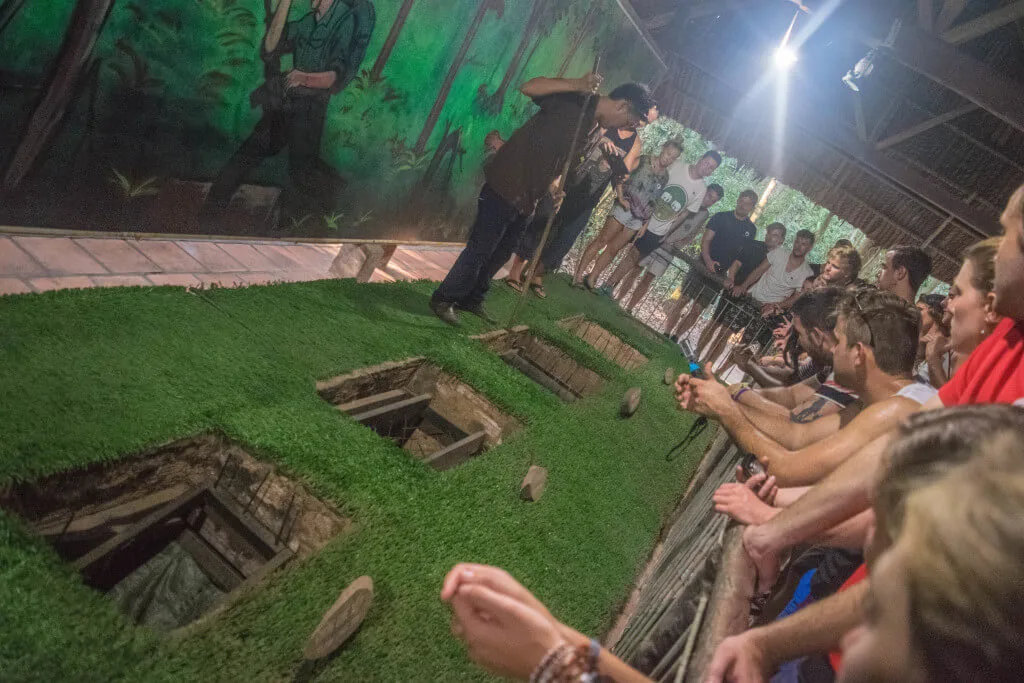


They also had a firing range on site here. It made the experience even more real to constantly hear gunfire in the background during our tour – pretty eerie, to be honest. Zoe and I figured that this of all times would be a great time to try our hand at shooting a gun – so we split 10 rounds and did it!
Lastly we got to actually go inside the tunnels. The craziest thing is that apparently the tunnels we went inside have been widened for tourists to be able to go inside; this was hard to believe because they were still TINY. They were maybe 1m tall and maybe about the same width, getting smaller at the top. To move you had to be in a full squat the entire time, shuffling along the musty dark walls. Some of the boys in our group didn’t even make it to the end of the tunnel system we were allowed to explore. My legs were definitely sore afterwards!

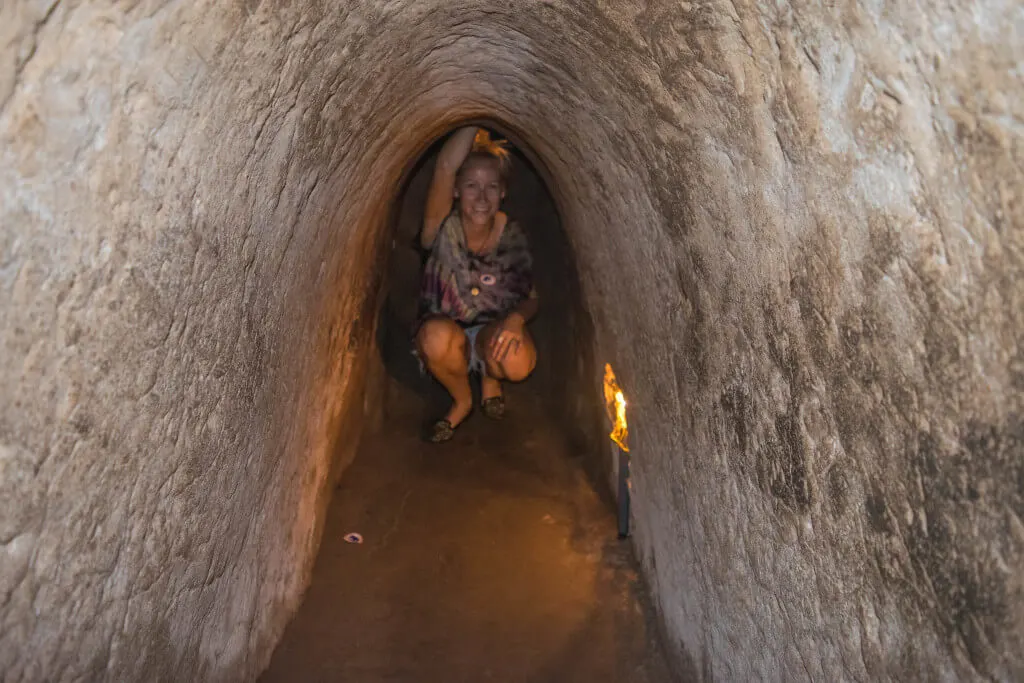
And, of course, they didn’t have lights or nearly as many air holes during the war! It’s very incredible that the VC actually lived down here and used their small size to such an advantage. I can’t imagine knowing the placement of each entrance, each booby trap, and how to navigate such a complex puzzle of dark tunnels.
It was strange to explore what it would have been like on the other side of the War. No matter how much less technologically equipped than the Americans, the Vietnamese could still fight in their own guerrilla ways. The booby traps really were tough to see, and while walking through the jungle I thought about how the traps or tunnel entrances could have been anywhere around here during the war. That must have been an intense life – for both sides!
Final Thoughts
I’m not going to pretend like I really know the first thing about war – not even the first thing. All of this is just my attempted outside understanding from my conversations with my dad and others, my travels through Vietnam, and some research.
I previously thought that enough time had passed since the Vietnam war that things should be pretty well smoothed over, but it is clear that is not so. Everywhere I went in Vietnam had something left over from the “American War,” and it has left a scar for generations to come. It will take a lot more than 40 years for this small country to forget the hell it went through in the late 60’s and early 70’s, for bombs to stop washing up in the jungle after strong rains, for areas affected by agent orange to be fertile enough to grow crops again.
In reality, I don’t think either side is right. War is such a messed up thing. America did some awful things during that period, as did the Vietnamese. Boys were drafted at a young age to take part in a war that was extremely controversial and met with an insane amount of hate. Young Americans were met with disdain simply for taking part in a war that many opposed, although many didn’t even have a choice. My father was one of them. He joined the Air Force because he knew he was going to be drafted and preferred to do it in a way he chose, which was being a pilot.
They went through ridiculously tough survival training, lived in jungles, and endured things that I honestly could not even dream of enduring – friends not coming back from their missions, severe injuries, near-death experiences and never really knowing if you will make it until tomorrow. I will be forever indebted to our Veterans for that. Going to fight in Vietnam for many was not a choice; whether right or wrong. It was duty. And my father was vilified when he came home just for being involved. Thinking about how veterans are treated rightfully as heroes nowadays, how awful would it be to go through such an awful experience and then be shunned upon arrival home?!
On the Vietnamese side, things were similarly hard. From my understanding, the South Vietnamese were torn between the Americans and the North Viet Cong Soldiers. VC would come down into the south and infiltrate smaller town and cities and force the inhabitants to help them – by fighting, concealing their whereabouts or ammunition, working for them, suicide bombing- and kill them or behead the village chief if they wouldn’t.
These same towns were the ones the Americans were helping fight the North. It was hard for the Vietnamese to know what side to be on, because many were fighting with the Americans but didn’t want to be killed by the VC. This lead America not to ever even know who the enemy was – VC would be farmers by day and then killers by night. They would even involve women and children in the fighting – sending them to bomb or distract troops. Anyone could be VC.
There was no clear cut friend/enemy line – an enormous frustration to Americans – leading to a lot of the atrocities that were committed during the war. They didn’t necessarily target women and children. They targeted the enemy, which sadly sometimes was women and children.
The way they portray the war here is that the Americans are barbarians who descended on a small innocent country for no reason at all. I know that tourists come from all over the world, each and every single day, not knowing anything about the Vietnam War and blindly consuming all this information. Hell, that was me in the prison in Hanoi! When you go to a museum the one thing you definitely do is take everything for a fact, because that is rooted in the definition of a museum.
They leave out the fact that the US went in to help South Vietnam fight off the North and stop all of Asia from potentially falling to communism. They leave mostly out China and Russia’s involvement altogether. They frame it to be so intensely anti-American. I’m sure America frames it the other away as well.
It is awful to see how they frame my dad, Zoe’s grandpa, my neighbor Steve. Being able to put faces to these “American aggressors’ just furthers the pain in the pit of my stomach that aches for both sides.
It really is sad. It’s sad Vietnam still has to portray the war like this to their young and to visitors traveling the country. It’s sad that it is framed so much. But it is also sad that this small little country had to go through so much terror. It’s sad that small cities in the southern Vietnamese countryside were subjected both to US soldiers and to the north trying to take over with a government they didn’t want. It’s sad this was basically a satellite war of the cold war between the US and Russia/China, at the expense of Vietnam. It’s sad this war even happened. It’s sad how many lives were changed for the worse.
I will not even begin to comment on the morality of the war because I am not remotely in a position to discuss that type of thing. But I do know that it brings out the absolute worst in humanity. It’s always a tough subject to talk about, and my dad has always told me not to dwell on it because it really is just so completely and entirely messed up. But being an American, especially a veteran’s daughter, traveling Vietnam, had given me so much more of a personal understanding and better outlook on some of the things that occurred.
Moreover, learning more about the war has helped me understand a lot more about my dad. He has always been a very straight, stern, by-the-rules person, and sometimes that would clash with my more open and free personality. I have known that many of his ways came from his military past. But, it really took my visiting to Vietnam and seeing first hand what he went through to be able to start to understand that his experience in the war has shaped the person he still is to this day. I still can’t begin to understand all he went through, but I sure did try to do as much as I could – giving me a more solid understanding of not only him but where I come from.

Passionate, full-time travel blogger with over 230k on social media and 150kMPV blog. Extraordinary photographer with two DSLR's + a drone with a love for capturing candid moments, epic drone shots, and magical compositions. I'm a natural-born content creator originally from California, but I've been on the road for 9 years living, working, traveling, blogging, and photographing my way around the world. I recommend the most amazingly adventurous and unique + boutique travel experiences/stays and helpful products to my audience and write comprehensive guides on my website that have helped millions of travelers so far. I love to inspire people to plan their dream trips, and many readers have given feedback as such. The reach on my platforms continues to soar, especially when combining cutting-edge social content with optimized articles on my high-authority website.
ig
Friday 24th of February 2017
I know this if off topic but I'm looking into starting my own weblog and was curious what all is required to get setup? I'm assuming having a blog like yours would cost a pretty penny? I'm not very internet savvy so I'm not 100% certain. Any recommendations or advice would be greatly appreciated. Appreciate it
Cynthia
Friday 19th of February 2016
This was such a different and nice read. Great article! :)
Taylor
Friday 19th of February 2016
Great post. I've always had an interest to go there, thanks for sharing!
alexa
Friday 19th of February 2016
What a thoughtful, interesting article. So much great information. Loved reading about this adventure and learning more about Vietnam and the war.
Jen Morrow
Tuesday 16th of February 2016
Sobering photos and descriptions. War is HELL, and we must learn from the past.